
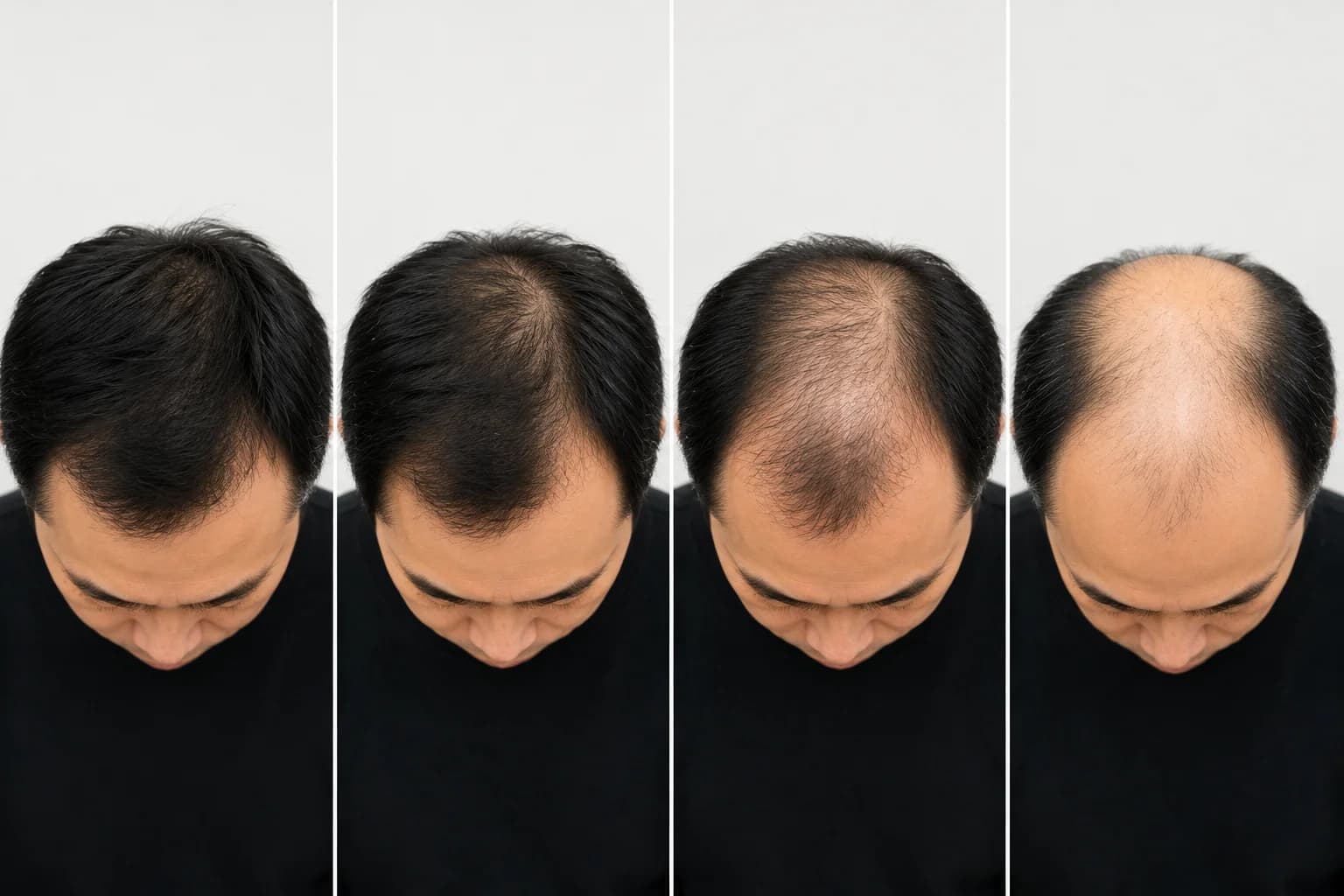

If you have been researching hair loss for more than five minutes, you have probably come across the word Norwood. Maybe in a clinic consultation, maybe in a forum, maybe on a product label claiming to work for certain stages of hair loss.
The Norwood Hamilton scale is the most widely used classification system for male pattern baldness. Understanding where your hair loss sits on this scale does not just give you a way to describe your situation. It directly shapes what treatments make clinical sense, what results are realistic, and how urgently intervention is recommended.
What the Norwood Scale Measures
The Norwood scale divides male pattern hair loss into seven main stages based on the pattern and extent of recession and thinning. It was developed by Dr. O’Tar Norwood in the 1970s based on earlier work by Dr. James Hamilton and has been the standard reference in hair restoration medicine ever since.
The scale focuses on two main areas of the scalp: the hairline at the front and temples, and the crown at the top of the head. How these two areas are affected, and how they relate to each other, defines each stage.
Norwood Stage: Recommended Treatments
| Norwood Stage | Hair Loss Description | Recommended Treatment |
|---|---|---|
| Stage 1 and 2 | No or slight recession | Minoxidil, finasteride, PRP. No surgery indicated |
| Stage 3 and 3 Vertex | Pronounced recession, early crown thinning | Medical treatment, PRP or exosome therapy, modest hairline transplant if needed |
| Stage 4 | Advanced recession, early crown separation | Medical treatment, PRP, surgery for hairline and early crown |
| Stage 5 and 6 | Front and crown thinning merging | Surgery increasingly central, medical treatment to protect remaining native hair |
| Stage 7 | Thin band remaining on sides and back only | Surgery with carefully calibrated expectations, scalp micropigmentation as alternative |
Why Your Norwood Stage Matters for Treatment
Your Norwood stage is not just a descriptive label. It is one of the primary factors determining which treatments are appropriate and what outcomes are realistic.
At Stage 1 and 2, preventive treatment makes the most sense. Starting minoxidil and or finasteride at this point has the best chance of keeping hair loss stable for a long time. PRP can enhance follicle health and reduce the rate of progression. No surgery is typically indicated. Our PRP hair treatment programme is a common starting point for patients at this stage who want clinical support beyond medication alone.
At Stage 3 and 3 Vertex, medical treatment remains important, and PRP or exosome therapy becomes a meaningful addition to the protocol. For patients whose hairline recession is bothering them aesthetically, a modest hair transplant procedure to restore the hairline while continuing medical management is reasonable.
At Stage 4, a combination approach is common. Medical management and PRP continue. Surgery becomes relevant for hairline restoration and potentially early crown work. The graft count needed is increasing. Our hair transplant in Malaysia guide covers what a Stage 4 consultation and procedure planning looks like in practical terms.
At Stage 5 and 6, surgery is increasingly central to any significant restoration. Medical treatments continue to protect remaining native hair. The graft requirement for meaningful coverage is substantial, and donor zone planning becomes critical to avoid depleting future options.
At Stage 7, the most advanced restoration is limited by how much donor hair is available. Surgery can still provide meaningful cosmetic improvement, but expectations need to be carefully calibrated. Some patients at this stage prefer scalp micropigmentation as an alternative approach.
The Norwood Scale for Women: The Ludwig Scale
The Norwood scale was developed specifically for male pattern hair loss. Women experience androgenetic alopecia differently, typically as diffuse thinning across the top of the scalp rather than the M-shaped hairline recession pattern.
The Ludwig scale is the equivalent classification for female pattern hair loss. Ludwig I is mild diffuse thinning visible primarily when the hair is parted. Ludwig II is more pronounced diffuse thinning with a wider parting. Ludwig III is extensive diffuse loss with the scalp clearly visible across the top.
Women tend to retain their frontal hairline, which distinguishes female pattern hair loss from the male Norwood pattern. For a full breakdown of what treatments are available for both male and female pattern hair loss in KL, our hair loss treatment overview covers every option and who each one suits.
How to Find Out Your Norwood Stage
Self-assessment using photos is possible but unreliable. Camera angle, lighting, and hair length all affect how recession appears in photographs.
The accurate approach is a clinical scalp assessment by a doctor who can examine the pattern, density, and miniaturization of follicles directly. A dermatoscope or trichoscope allows much more detailed evaluation than visual inspection alone.
A proper Norwood classification during your consultation gives you and your doctor a common language and a clear reference point for planning treatment.
Does Your Norwood Stage Change Over Time
Yes. For most men, pattern hair loss is progressive over years and decades. How quickly it progresses varies enormously by individual, genetics, and whether treatment is in place.
Starting treatment at Stage 2 or 3, when follicles are still relatively healthy, gives the best chance of slowing progression significantly. Waiting until Stage 5 or 6 limits what medical and regenerative treatments can achieve, leaving surgery as the primary remaining option.
This is why the Norwood scale matters not just for what it tells you today but for what it implies about acting sooner rather than later. For patients approaching the stage where a transplant may be appropriate, our FUE hair transplant Malaysia page explains how graft planning is approached by Norwood stage in a surgical context.
Book a consultation at Nexus Clinic for a proper Norwood assessment and a treatment plan matched to your current stage.
Frequently Asked Questions
Can I assess my own Norwood stage from photos?
Roughly, but not reliably. Camera angle, lighting, and hair length all distort how recession appears. A proper clinical assessment by a doctor is far more accurate and gives you a clinically useful picture.
Does everyone with male pattern baldness progress to Stage 7?
No. Many men stabilise at lower stages, particularly with treatment. Genetics determines the potential progression trajectory, but it is not inevitable that everyone reaches the most advanced stages.
At what Norwood stage should I start treating hair loss?
The earlier the better. Stage 2 or even Stage 1 with a family history of advanced hair loss is a sensible time to begin preventive medical management. Waiting for advanced stages before acting limits what is achievable.
Is Norwood Stage 4 too late for a hair transplant?
Not at all. Stage 4 is a common presentation for hair transplant patients. The graft count needed is significant but the donor zone is typically sufficient for meaningful restoration when planned carefully.
Can PRP help at Norwood Stage 5 or above?
PRP can still support follicle health in areas where active thinning is occurring. However, areas of complete hair loss at advanced Norwood stages will not respond to PRP alone. Surgery is needed to restore coverage in those zones.
Is there a Norwood equivalent scale for women?
Yes. The Ludwig scale is the standard classification for female pattern hair loss. Women’s pattern baldness presents differently from men’s, typically as diffuse thinning rather than frontal recession, and the Ludwig scale reflects this.
Does stress cause advancement through Norwood stages?
Stress-related shedding (telogen effluvium) can cause temporary increased loss but does not directly advance the Norwood stage. Norwood progression is driven by DHT and genetic sensitivity of follicles. However, severe chronic stress can worsen the environment in which pattern hair loss progresses.
What is a miniaturization ratio and how does it relate to Norwood stage?
Miniaturization refers to the progressive shrinking of the follicle diameter over time due to DHT sensitivity. A high miniaturization ratio in a given area indicates the follicles there are deteriorating. Trichoscopy can measure this and it helps predict which areas will respond to treatment and which may already be too far gone.
Does the Norwood scale apply to beard or eyebrow hair loss?
No. The Norwood scale is specific to scalp hair loss. Different assessment approaches are used for beard, eyebrow, and body hair loss patterns.
What is the most common Norwood stage at which Malaysians seek treatment?
Anecdotally, many Malaysian men seek their first hair loss consultation at Stage 3 or 4, when recession or crown thinning has become visually noticeable to others. Awareness is growing that earlier intervention at Stage 2 produces better long-term outcomes.
✓ Reviewed by Dr. Preetha Nair, Aesthetic Medical Doctor – Nexus Clinic KL