
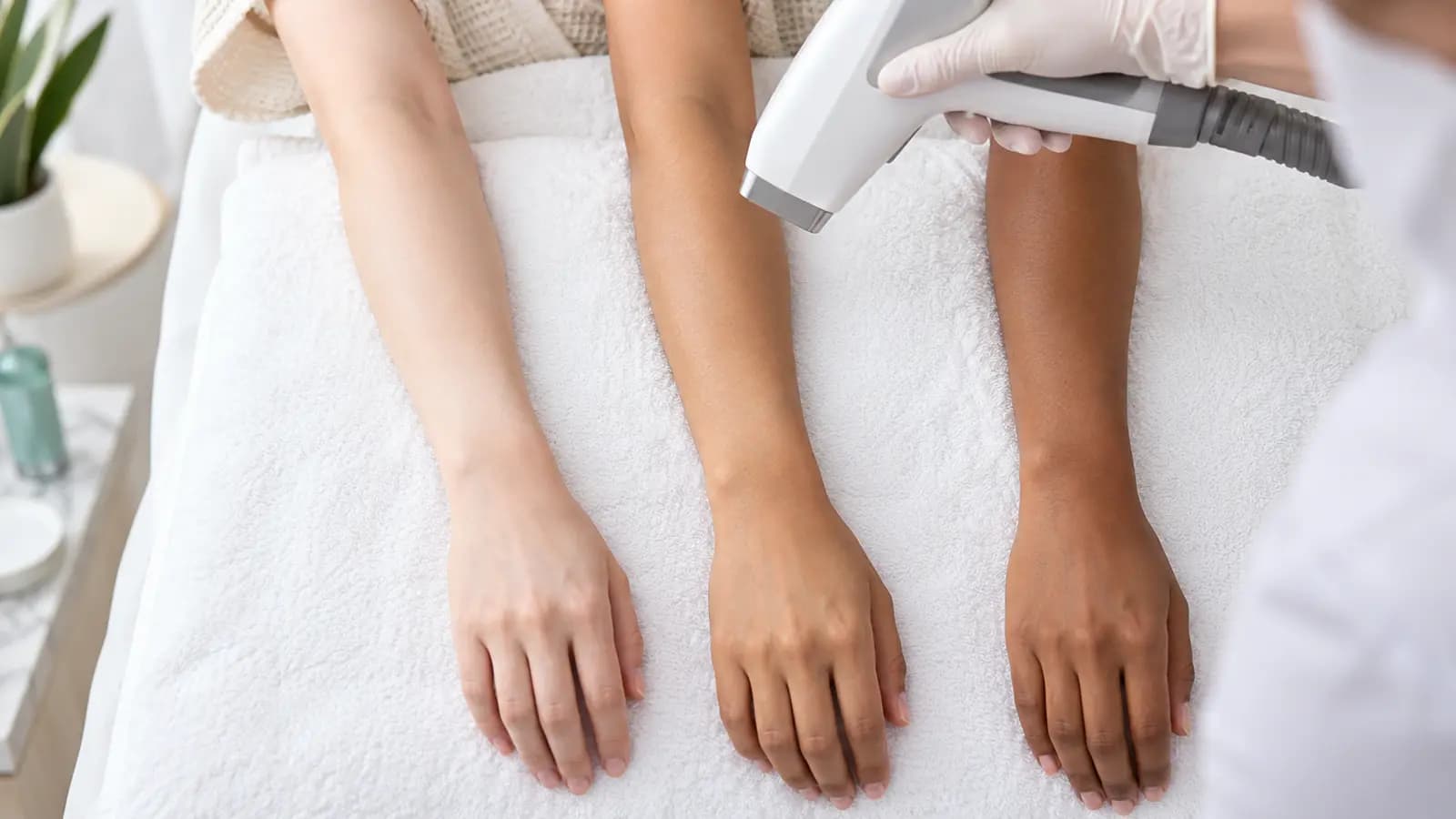

The shorter the wavelength, the closer the laser beam is to being attracted to pigment. The longer the wavelength, the deeper the penetration and the less consideration for pigment the laser beam is able to make. This simple physics principle underpins almost everything that distinguishes Alexandrite, diode, and Nd:YAG lasers in practice, which is exactly why “the best” laser for laser hair removal is genuinely dependent on your skin tone, not your budget or the marketing of the clinic. For a country that has a population broadly falling into the Fitzpatrick III to V category, this isn't a minor point of distinction: it's the difference between a treatment that successfully removes hair safely and a treatment that burns or damages existing skin pigment.
Three Lasers, Three Wavelengths
| Alexandrite | Diode | Nd:YAG | |
|---|---|---|---|
| Wavelength | 755nm | 800 to 810nm | 1064nm |
| Melanin absorption | High absorption across melanin | Moderate absorption across melanin | Low absorption across melanin, reaches below |
| Best suited to | Fitzpatrick I to III skin | Fitzpatrick II to IV skin | Fitzpatrick IV to VI skin |
| Hair type | Fine to coarse dark hair | Coarse hair across range | Coarse, dark hair, less efficient with fine hair |
| Comfort | Can feel more intense on darker or tanned skin | Generally comfortable with cooling systems | Often described as more tolerable for darker skin, requires higher energy |
| Risk on darker/tanned skin | Higher risk on tanned or darker skin | Moderate risk at upper Fitzpatrick range | Lowest risk on tanned or darker skin |
Alexandrite: Fast and Precise, Only for Lighter Skin
Alexandrite works with the shortest of the three wavelengths, meaning it is well absorbed by melanin. This makes it a fast, effective choice for fine to coarse dark hair on light skin, as the laser is able to easily differentiate the hair pigment from the skin colour itself. It is also that same reason that Alexandrite lasers are genuinely risky for darker or tanned skin; on Fitzpatrick IV to VI skin, the same high absorption across melanin is starting to affect skin pigment, raising concern for burns, blistering, and other negative interactions. For a country with a population broadly fitting into Fitzpatrick III to V, Alexandrite alone is simply not the safe default it might be marketed as elsewhere.
Diode: The Workhorse, With a Ceiling
Diode falls in the middle of the three wavelengths, reaching effectively into the follicle while being less focussed on surface pigment than Alexandrite. It is, on the whole, the most common type used in the professional sphere, and for good reason; it is capable of working across a genuine range of skin tones and hair types, and has a reasonable safety margin on Fitzpatrick II to IV skin. Modern diode systems, using in motion or gliding techniques, also generally provide a more comfortable experience than older stamping designs.
Where diode falls short is on the top end of the Fitzpatrick scale: working with Types V and VI puts the laser at similar risk of adverse interactions as Alexandrite does, since surface melanin absorption increases the risk of those interactions occurring if settings are not careful. It is a good middle-ground option, but it is not the answer for every skin tone on its own.
Nd:YAG: Gold Standard for Dark Skin
Nd:YAG works with the longest of the three wavelengths, 1064nm. This allows it to bypass surface melanin to effectively reach the hair follicle, and is the reason for its genuine clinical recommendation across the FDA for Fitzpatrick IV to VI skin. Studies conducted on Indian patients (with similar skin tones to the Malaysian population) have also found long-pulsed 1064nm Nd:YAG to be genuinely effective and safer for dark skin than other shorter wavelength lasers.
Nd:YAG's longer wavelength also means that it has lower melanin absorption across the skin, and while it is capable of achieving similar follicle damage to other wavelengths it generally requires a higher energy setting to do so. It is less efficient on fine, light hair specifically, but for coarse, dark hair on darker skin, it remains a genuinely safe option.
What This Actually Means for Malaysian Skin
Malaysia's population broadly falls into the Fitzpatrick III to V category, although there is a genuine range of skin tones across individuals within that category. That has several practical implications worth knowing:
- If your skin tone falls towards the Fitzpatrick I to III category, and doesn't tan easily, Alexandrite or diode can be effective and efficient options
- If your skin tone tans easily or is towards the Fitzpatrick IV category, diode with conservative settings or Nd:YAG tends to offer a safer margin
- If your skin tone is towards the Fitzpatrick V to VI category, Nd:YAG is generally the safer choice (although it may require more sessions or higher energy to achieve comparable results on finer hair)
A recent tan, however, will temporarily change your skin tone, and for that reason even someone who generally falls into Fitzpatrick II or III should be treating their skin as darker than normal in the aftermath of a sunbed or tan. The actual melanin content at the time of treatment is what matters, not your skin tone alone. This is also why many established clinics now use multi-wavelength systems that provide two or more laser wavelengths in one system, being able to switch between diode and Nd:YAG, for instance, as needed grants much greater flexibility than a single-wavelength system can provide.
What a Consultation Should Actually Assess
Prior to recommending a specific wavelength, a proper consultation will consider a number of factors beyond how fair/dark you look at first glance. Your actual Fitzpatrick skin type (properly assessed), recent sun exposure or tanning (which temporarily shifts your skin type), your hair colour and coarseness in the treatment area, and any history of pigment changes or unusual reactions to hair removal. You can read more about laser hair removal and what to expect from a full course of treatments on the clinic's dedicated page.
A Few Things Worth Knowing Before You Book
- The “best” laser genuinely depends on your specific skin and hair, not a universal ranking. A clinic recommending the same laser type for every patient regardless of skin tone is a red flag.
- Fine, light coloured hair is genuinely harder to treat with any of these three lasers, since all of them rely on melanin absorption in the hair itself
- Multiple sessions are standard across all three laser types, since hair grows in cycles and only actively growing follicles respond well to treatment at any given session
- If you tan regularly or have recently been in strong sun, mention this clearly during consultation, since it directly affects which wavelength and settings are safe to use
- Cooling technology built into modern devices significantly improves comfort regardless of which wavelength is used, this is worth asking about if comfort is a concern.
Frequently Asked Questions
Which laser is safest for darker Malaysian skin tones?
Nd:YAG at 1064nm is generally considered the gold standard for Fitzpatrick IV to VI skin, since its longer wavelength bypasses surface melanin and reaches the hair follicle with a lower risk of burns or pigment changes.
Is Alexandrite laser suitable for Malaysian skin?
It can be, for lighter skin tones that don't tan easily, roughly Fitzpatrick I to III. For darker or frequently tanned skin, Alexandrite carries a higher risk profile than diode or Nd:YAG.
Why do some clinics use more than one laser wavelength?
Multi-wavelength systems allow a practitioner to match the safest, most effective wavelength to each patient's actual skin tone and hair type, rather than forcing every patient through the same single-wavelength device.
Does diode laser work on all skin tones?
Diode handles a broad range, generally Fitzpatrick II to IV, reasonably well, but it faces similar risks to Alexandrite at the upper end of the Fitzpatrick spectrum, Types V and VI, where Nd:YAG is typically the safer choice.
Will laser hair removal work on fine or light coloured hair?
All three lasers rely on melanin absorption in the hair itself, so fine or light coloured hair generally responds less predictably regardless of which wavelength is used.
Does recent tanning affect which laser I should use?
Yes, significant recent sun exposure temporarily increases melanin in the skin, which should be factored into wavelength and settings selection even if your baseline skin tone is normally lighter.
Not Sure Which Laser Wavelength Actually Suits Your Skin?
Skin tone, hair type, and how easily you tan all factor into which wavelength is genuinely safe and effective for you, and that's a much clearer conversation in person than online. Book a consultation with the team at Nexus Clinic KL for a proper skin and hair assessment, or message us on WhatsApp if you'd like to ask a few questions first.