
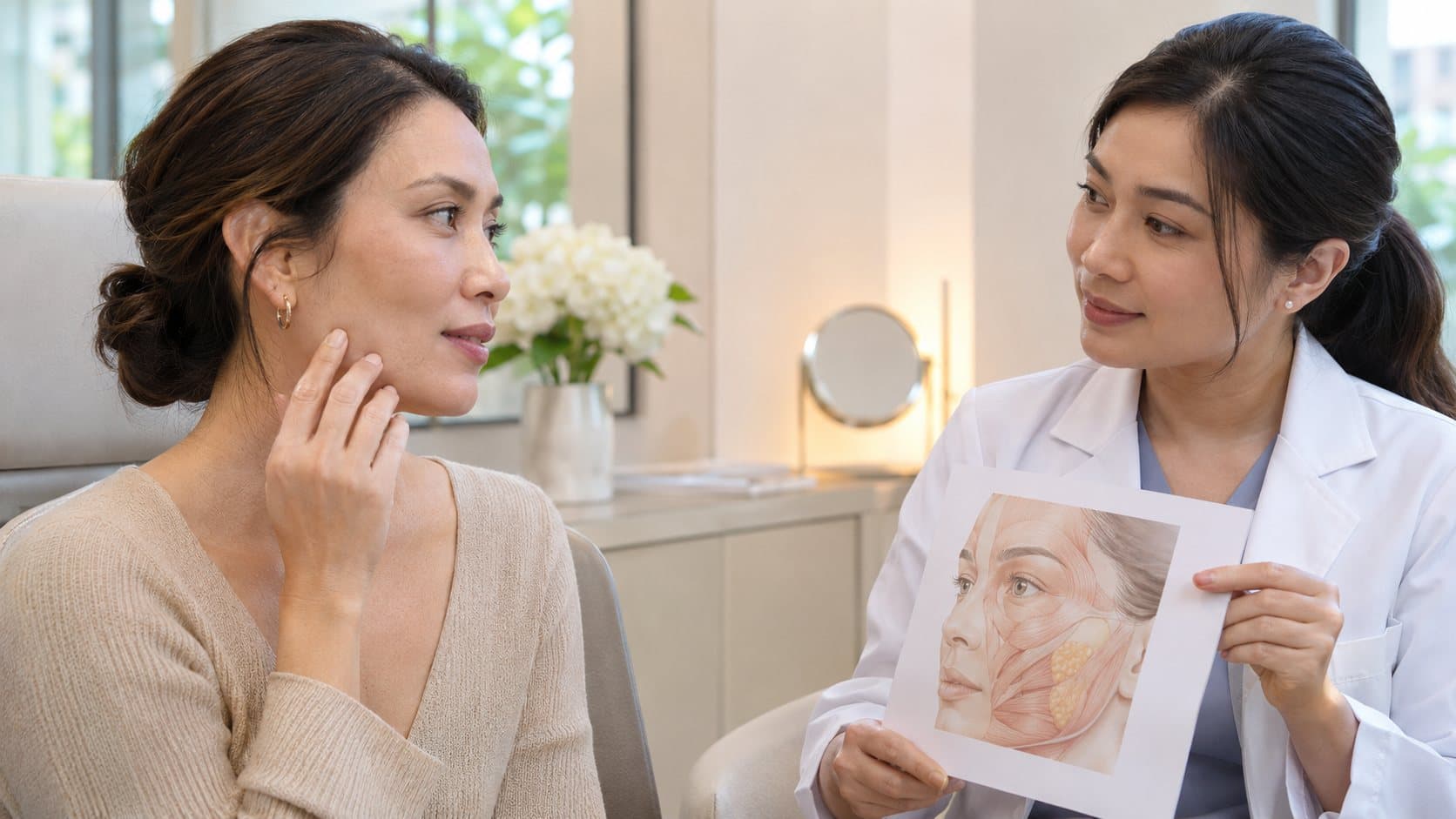

Achieving significant body weight loss is a major health milestone. Whether accomplished through lifestyle restructuring, modern medical interventions, or specialized fitness regimes, reducing overall body fat yields substantial cardiovascular and metabolic benefits. However, many individuals in Malaysia notice an unexpected side effect as the numbers on the scale drop: sudden, noticeable changes in their facial structure. The loss of soft tissue mass often leads to hollowed temples, sunken mid-face areas, and an overall tired or aged appearance.
This transformation occurs because fat reduction cannot be localized or targeted strictly to the abdomen, thighs, or arms. When the body consumes energy reserves, deep and superficial fat compartments across the entire body deplete concurrently, including the specialized adipose layers supporting the face. In urban medical aesthetics practices across Kuala Lumpur, patients frequently seek guidance on how to address this disparity between a healthier body and a gaunt facial appearance. Understanding the structural dynamics of facial anatomy during weight loss enables individuals to make informed decisions about restoration. For those currently exploring structured body transformation, enrolling in a medically supervised doctor-led weight management programme provides professional oversight to help monitor nutritional balance and metabolic stability throughout the weight loss journey.
Why Rapid Weight Loss Changes the Face
To understand why significant weight reduction dramatically alters facial proportions, one must examine the complex, multi-layered architecture of human facial anatomy. The face is composed of distinct structural layers: the bony scaffold, deep fat compartments, superficial fat compartments, the Superficial Musculoaponeurotic System (SMAS) muscular layer, and the overlying dermis.
Rapid weight reduction impacts every layer of this complex network:
- Deep Facial Fat Pad Atrophy: Deep fat pads act as crucial structural pillars, resting directly above the facial periosteum to support the mid-face, cheeks, and temples. When body fat decreases rapidly, these deep compartments shrink substantially. Deprived of their volume, the overlying muscular and cutaneous structures lose their primary supportive foundation, causing the mid-face to collapse inward and downward.
- Structural Fat Loss vs. Superficial Skin Shrinkage: Facial skin possesses elastic properties governed by collagen and elastin fibers within the dermis. However, structural fat reduction often occurs at a speed that vastly exceeds the skin’s natural rate of elastic retraction. While deep structural fat disappears quickly, superficial skin cannot shrink fast enough to match the reduced structural perimeter, resulting in excess, deflated tissue.
- SMAS Layer Laxity: The SMAS is a continuous fibrous muscular network connecting facial muscles to the dermis. Deep fat loss creates void spaces directly beneath the SMAS layer. Without internal mechanical support, the tension of the SMAS weakens, causing facial contours to migrate downward under the continuous influence of gravity.
- Accelerated Collagen Degradation: Rapid weight loss is frequently accompanied by temporary caloric deficits, alterations in micronutrient absorption, and transient metabolic stress. Elevated cortisol levels combined with reduced structural protein synthesis can weaken the dermal extracellular matrix, accelerating the breakdown of collagen types I and III and compromising dermal density.
When these factors converge, the facial envelope loses both its internal volumetric structural support and its external dermal elasticity, leading to structural deflation rather than simple surface skin aging.
Signs: Hollow Cheeks, Temples, Jowls and Laxity
Facial deflation manifests differently depending on individual bone structure, age, genetics, and the total percentage of body weight lost. However, clinical patterns consistently emerge across specific aesthetic zones of the face.
Sunken Temples and Temporal Hollowing
The temporal fossa relies heavily on both the temporalis muscle and the temporal fat pad for smooth, youthful contours. When temporal fat depletes, the lateral orbital rim and zygomatic arch become sharply pronounced. This gives the upper third of the face a skeletonized or severely fatigued appearance, altering the overall facial oval.
Hollow Tear Troughs and Infraorbital Deflation
The delicate region beneath the eyes is exceptionally sensitive to subtle volume changes. As the periorbital and sub-orbicularis oculi fat (SOOF) thin out, the tear trough ligament becomes visibly highlighted. This structural shift creates deep shadows beneath the lower eyelids, giving the appearance of persistent dark circles that cannot be resolved through topical skin care alone.
Gaunt Mid-Face and Flattened Cheeks
Youthful cheeks feature a smooth, convex curve known aesthetically as the "Ogee curve." Depletion of the anterior malar and buccal fat pads causes this curve to flatten or invert. The mid-face loses its natural apex, causing the cheek area to look hollow and drawn.
Deepening Nasolabial Folds and Marionette Lines
As the mid-facial fat pads collapse, the skin and superficial tissue folds downward toward the mouth. This tissue descent pools along the structural boundaries of the lower face, deepening the nasolabial folds running from the nose to the corners of the mouth, as well as the marionette lines extending downward toward the chin.
Jowling and Jawline Laxity
The lower border of the mandible gradually loses its crisp definition as descending facial tissues accumulate along the jawline. The structural breakdown of pre-auricular fat and lower cheek volume, combined with dermal laxity, allows skin to spill over the mandibular border, forming noticeable jowls.
When to Treat (Weight Stable for 3 Months)
A critical factor in successfully treating post-weight loss facial deflation is precise timing. Patients are strongly advised to achieve stable body weight for a minimum of three consecutive months prior to undergoing injectable, tissue-stimulating, or bio-remodeling procedures.
Initiating corrective clinical treatments while body weight is actively fluctuating introduces several clinical challenges:
- Target Volumization Instability: Injecting dermal volumizers or collagen stimulators into a face that is still actively losing fat makes predicting long-term structural outcomes nearly impossible. A correction that appears balanced today may become insufficient weeks later if systemic fat loss continues.
- Metabolic Stabilization: Rapid weight loss places the body in a catabolic state. For biostimulatory treatments to work effectively, the body’s metabolic processes must shift back into an anabolic or stable state where tissue synthesis, fibroblast activity, and collagen deposition can occur predictably.
- Accurate Structural Assessment: A stabilized baseline allows medical practitioners to evaluate precise structural deficits, distinguishing between fixed anatomical volume loss and temporary tissue dehydration or stress-induced skin changes.
With proper doctor assessment and tailored dosing, patients can achieve natural-looking, balanced facial volume restoration over time.
Options Compared: Collagen Stimulators, HA Fillers, Profhilo, Skin Boosters
Restoring facial structure following weight loss requires a clear understanding of the available aesthetic options. Treatments differ fundamentally in their mechanisms: some physically replace missing space immediately, while others stimulate the body's natural regenerative processes to rebuild lost tissue components over time.
| Treatment Option | Primary Mechanism | Best For | Ideal Candidate | Typical Duration |
|---|---|---|---|---|
| Sculptra (PLLA) | Poly-L-Lactic Acid biostimulation triggers deep neocollagenesis | Structural volume restoration in mid-face, temples, and jawline | Patients with diffuse facial hollowing seeking gradual, long-term restoration | Up to 24 months |
| HA Dermal Fillers | Cross-linked Hyaluronic Acid physically lifts and fills space immediately | Targeted deep structural support, tear troughs, and precise contouring | Patients needing instant correction for localized volume deficits | 9 to 18 months |
| Profhilo | High- and low-molecular weight HA bio-remodeling for cell signaling | Dermal elasticity, skin laxity, and multi-layer tissue hydration | Patients with thin, crepey skin and moderate tissue sagging | 6 to 9 months |
| Skin Boosters | Micro-droplet non-cross-linked HA and nutrients into superficial dermis | Fine surface line reduction, brightness, and superficial hydration | Patients with superficial dullness and fine skin dehydration | 3 to 6 months |
Sculptra Collagen Biostimulation
Poly-L-Lactic Acid (PLLA), such as Sculptra collagen stimulator, represents a primary clinical choice for global, diffuse facial volume loss. Unlike temporary gel space-fillers, PLLA acts as a biostimulatory signal. Micro-particles of PLLA are injected into the deep sub-dermal or periosteal layers, triggering a controlled, benign sub-clinical inflammatory response.
This response activates host fibroblasts, encouraging them to deposit new native collagen types I and III around the biodegradable micro-spheres over several months. Using Sculptra for volume loss is particularly advantageous for post-weight loss patients because it gradually restores the natural deep structural matrix, providing a durable, smooth restoration without risking an artificial or overly "filled" appearance.
Hyaluronic Acid (HA) Dermal Fillers
For immediate structural restoration or highly localized deficits, cross-linked hyaluronic acid gels serve as a reliable solution. Modern dermal fillers in Malaysia are engineered with varying rheological properties, G-prime values, and cross-linking densities. High G-prime HA gels act as rigid structural pillars when placed deep against bone, successfully lifting heavy overlying tissues in the cheek and cheekbone areas. Lower G-prime gels provide smooth integration for superficial zones like the tear troughs or perioral region. The primary advantage of HA fillers is immediate visual gratification and precise control over contour adjustments.
Profhilo Bio-Remodeling
When weight loss results in generalized skin crinkling, crepey texture, and mild-to-moderate tissue sagging rather than deep structural hollows, bio-remodeling offers an alternative pathway. Profhilo bio-remodeling utilizes thermally cross-linked, highly concentrated Hyaluronic Acid. Upon injection at specific Bio-Aesthetic Points (BAP), the fluid spreads smoothly across tissue layers. It continuously releases HA to hydrate the dermal matrix while stimulating four distinct types of collagen and elastin within the keratinocyte, fibroblast, and adipocyte layers. This process tightens the dermal envelope and restores skin springiness.
Dermal Skin Boosters
Skin boosters consist of non-cross-linked or minimally cross-linked HA formulas, often enriched with essential amino acids, antioxidants, and minerals. Micro-injections are delivered uniformly into the superficial dermis. While skin boosters do not lift heavy structural folds or replace deep fat pads, they restore superficial hydration, enhance dermal thickness, smooth surface micro-lines, and improve overall skin luminosity compromised during intense dietary restrictions.
Need a personalized consultation for post-weight loss facial rejuvenation? Contact Nexus Clinic KL via WhatsApp at +60 16-824 5699 to schedule your medical evaluation with Dr. Preetha Nair.
To rebuild sunken facial contours caused by rapid weight loss, consider a targeted Sculptra volume restoration plan.
Combat post-weight-loss skin sagging and loss of elasticity with Profhilo bio-remodeling treatments.
How Many Sessions and Typical Timeline
Restoring facial structure after significant weight reduction is a progressive, step-by-step process rather than a single procedure. Because biological tissue remodeling requires time, patients should anticipate a structured treatment protocol designed to build durable results safely.
[ Week 0 ] Initial Consultation & Primary Injections
   │
   ▼ (4 to 6 Weeks)
[ Week 4-6 ] Medical Review & Protocol Adjustment / Session 2
   │
   ▼ (4 to 6 Weeks)
[ Week 8-12 ] Final Maintenance Session (If Required)
   │
   ▼ (Ongoing)
[ Months 12-24 ] Collagen Synthesis Peak & Sustained Results
Treatment Protocol Length: Biostimulatory protocols typically involve 2 to 3 treatment sessions, spaced over a period of 2 to 4 months, depending on the severity of fat pad depletion and the patient's biological response.
Session Spacing: Procedures are typically spaced 4 to 6 weeks apart. This interval allows dermal tissue to respond to biostimulatory triggers, permits swelling to fully resolve, and gives the practitioner an accurate baseline to assess required volume for subsequent sessions.
Onset of Results (Gradual vs. Immediate):
- Hyaluronic Acid Fillers: Provide immediate mechanical volume replacement visible right after treatment, with final tissue integration completing within 14 days.
- Biostimulators (Sculptra): Show subtle initial swelling that subsides within days. True biological volumization develops gradually over 6 to 12 weeks as new collagen matrix networks are synthesized.
Longevity and Maintenance: Biostimulatory results can persist for up to 24 months, as the newly formed collagen matrix becomes part of the body's natural tissue structure. Maintenance evaluations are generally recommended every 12 to 18 months to preserve harmonious facial balance.
Who Should Wait or Avoid Treatment
While medical aesthetic treatments are generally safe, clinical safety requires careful screening. Certain individuals should postpone or avoid structural facial procedures:
- Active Body Weight Instability: Individuals actively losing weight or undergoing ongoing dosage adjustments in medical weight management should wait until their weight stabilizes.
- Active Cutaneous Infections or Inflammation: Patients with active facial acne flares, bacterial skin infections, cold sores, or eczema breakouts near potential injection sites must delay treatment until the skin has completely healed.
- Uncontrolled Autoimmune or Systemic Disorders: Conditions that compromise immune function or alter normal inflammatory responses can impair collagen synthesis and increase complications like granuloma formation or delayed wound healing.
- Unrealistic Aesthetic Expectations: Patients seeking complete facial transformation without allowing adequate time for biostimulatory processes should re-evaluate their expectations during initial consultations.
Frequently Asked Questions (FAQ)
Q1: Will facial volume return naturally after weight loss?
No. Facial fat cells that have shrunk will not selectively regain volume unless systemic body fat increases. Age-related collagen reduction also prevents natural spontaneous structural recovery.
Q2: Is Sculptra or dermal filler better for sunken cheeks?
Sculptra is often preferred for deeper structural collagen stimulation and gradual volume restoration, whereas hyaluronic acid fillers or skin boosters may be better suited for immediate surface hydration or fine lines depending on individual facial anatomy.
Q3: Can I get facial treatments while still losing weight?
It is medically advisable to wait until your body weight remains stable for at least three months. Continuous weight loss alters facial proportions, compromising treatment precision and longevity.
Q4: How long do Sculptra volume results last?
Sculptra results typically persist for up to two years. The procedure stimulates your body's natural collagen production, which degrades slowly through natural aging processes over time.
Q5: Are post-weight loss facial treatments painful?
Discomfort is minimal. Aesthetic practitioners utilize fine needles or blunt-tip micro-cannulas along with topical numbing creams and local anesthetics integrated directly within the treatment products to ensure patient comfort.
✓ Reviewed by Dr. Preetha Nair, Aesthetic Medical Doctor – Nexus Clinic KL