
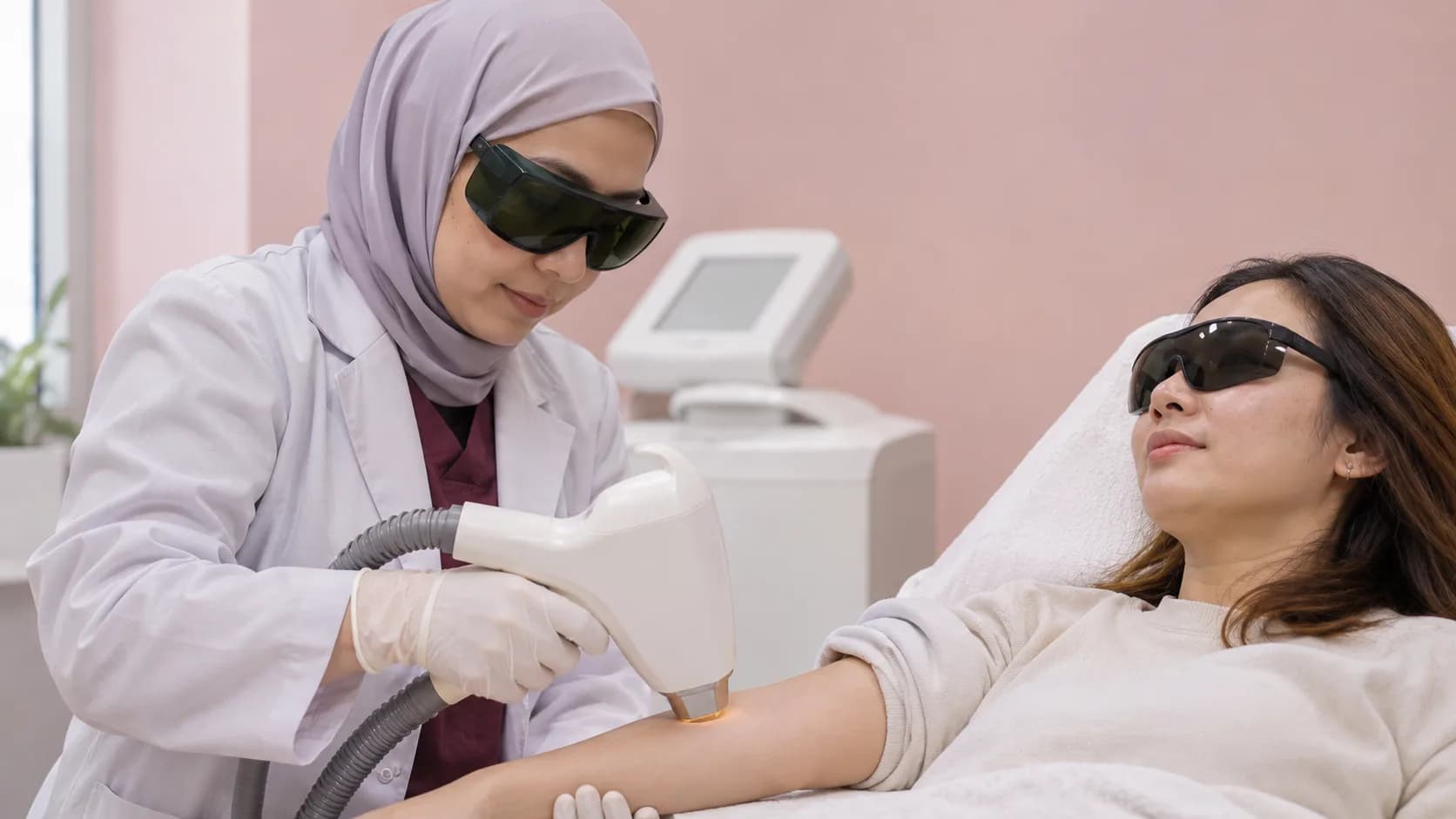

When comparing permanent hair reduction options in Malaysia, patients frequently weigh Intense Pulsed Light (IPL) devices against medical-grade laser hair removal systems. For Asian skin tones predominantly categorized as Fitzpatrick skin types III through V medical-grade lasers operating at specific monochromatic wavelengths (such as the 755nm Alexandrite, 810nm Diode, or 1064nm Nd:YAG) offer superior precision, deeper follicle destruction, and significantly longer-lasting hair reduction compared to broad-spectrum IPL systems.
The Core Technological Difference: Laser vs. IPL
To understand why medical laser consistently outperforms IPL in clinical practice, it helps to examine how each technology generates, focuses, and delivers light energy to target hair follicles:
- Medical Laser Hair Removal: Utilises a single, coherent, monochromatic beam of light focused at a precise wavelength. This concentrated wavelength is selectively absorbed by the melanin pigment inside the hair shaft, generating localized thermal energy that destroys the germinative stem cells at the root without scattering heat into the surrounding skin.
- Intense Pulsed Light (IPL): Utilises a broad spectrum of scattered, incoherent, polychromatic light (similar to a high-powered camera flash) encompassing multiple wavelengths simultaneously (typically ranging from 500nm to 1200nm). Because the light energy is scattered across a wide spectrum, less concentrated energy reaches the deep hair follicle, and a higher proportion of thermal energy is absorbed by the surrounding epidermal skin layers.
Why Skin Tone Matters in Malaysia
Malaysia's diverse population features predominantly Fitzpatrick skin phototypes III, IV, and V, characterized by higher baseline levels of epidermal melanin. Melanin is present not only inside your hair follicles but also dispersed throughout the upper layers of your skin.
- The IPL Risk Profile on Asian Skin: Because IPL emits broad-spectrum light, excess epidermal melanin absorbs the scattered thermal energy indiscriminately. On darker, olive, or tanned Asian skin types, this absorption increases the risk of surface burns, superficial blistering, hypopigmentation, and post-inflammatory hyperpigmentation (PIH).
- The Medical Laser Advantage: Advanced medical lasers bypass surface epidermal melanin safely by employing longer, targeted wavelengths (such as the 1064nm Long-Pulsed Nd:YAG) or advanced dynamic contact cooling tips. These technologies protect the epidermis from thermal damage while delivering deep, concentrated energy directly to the hair bulb and vascular feeder vessels. To explore clinical safety profiles and advanced treatment protocols, visit our laser hair removal in Malaysia guide.
In-Depth Wavelength Comparison for Asian Fitzpatrick Types
Understanding how specific laser wavelengths interact with Asian skin helps patients make informed treatment choices:
- 755nm Alexandrite Laser: High melanin absorption makes this wavelength exceptionally effective for fine to medium hair on fair to medium Asian skin (Fitzpatrick Types III). However, cautious fluence settings are necessary to prevent epidermal heating on darker skin tones.
- 810nm Diode Laser: Highly versatile with a deeper penetration depth than the Alexandrite. It offers a balanced ratio of melanin absorption and dermal safety, making it suitable for medium to dark hair across Fitzpatrick Types III and IV.
- 1064nm Nd:YAG Laser: The gold standard for safety on darker Asian skin tones (Fitzpatrick Types IV and V). Its longer wavelength bypasses epidermal melanin, penetrating deep into the dermis to target the hair follicle base directly without thermal risk to the surface skin.
Technical & Clinical Feature Matrix
| Feature / Metric | Medical-Grade Laser Systems | Intense Pulsed Light (IPL) Systems |
|---|---|---|
| Light Characteristics | Monochromatic, coherent, collimated beam | Polychromatic, incoherent, broad spectrum |
| Follicle Target Precision | Exceptional selective photothermolysis | Diffuse heating over a wide tissue area |
| Depth of Penetration | Deep (up to 4–5 mm into the dermis) | Shallow to moderate (2–3 mm dispersion) |
| PIH Risk on Fitzpatrick III–V | Minimal when appropriate wavelength selected | Elevated due to non-selective surface absorption |
| Treatment Comfort | Integrated sapphire contact cooling | Basic gel coupling; higher surface heat |
Comparing IPL and Medical Laser Side-by-Side
| Feature | Medical Laser Hair Removal (Alexandrite / Diode / Nd:YAG) | Intense Pulsed Light (IPL) Systems |
|---|---|---|
| Light Source | Monochromatic, coherent, single wavelength | Polychromatic, scattered broadband light |
| Follicle Penetration | Deep, targeted delivery to the hair bulb | Shallower, scattered thermal spread |
| Suitability for Asian Skin | High safety profile when using appropriate wavelengths (e.g., Nd:YAG) | Higher risk of pigmentation changes on darker or tanned skin |
| Long-Term Efficacy | Permanent hair reduction across 6 to 8 sessions | Slower results; often provides temporary hair reduction or finer regrowth |
Why Professional Laser Lasts Longer Than IPL
Because IPL delivers weaker, scattered light energy, it frequently stuns or miniaturises hair follicles rather than permanently damaging the bulb and matrix cells responsible for hair regeneration. This thermal insufficiency causes hair growth to pause temporarily before returning within a few months, often as fine, stubborn stubble.
Medical-grade lasers, by contrast, deliver precise peak power to the follicle during its active growth phase (anagen). This process known as selective photothermolysis denatures the stem cells and vascular supply feeding the hair root. Once destroyed, these targeted follicles cannot generate new hair shafts, resulting in permanent hair reduction and long-lasting smooth skin across the treated area.
Pre-Treatment and Post-Treatment Care Protocols
Achieving optimal, long-lasting results with medical laser technology requires proper preparation and post-care, particularly for Asian skin prone to post-inflammatory hyperpigmentation:
- Pre-Treatment Guidelines: Avoid sun exposure, tanning beds, and self-tanning products for at least two weeks prior to your session. Shave the treatment area 24 hours before your appointment; do not wax, pluck, or thread for four weeks prior, as the hair root must remain intact within the follicle to absorb laser energy.
- Post-Treatment Protocols: Apply a soothing aloe vera gel or prescribed calming cream to cooled skin immediately following treatment. Avoid hot showers, saunas, steam rooms, and vigorous exercise for 24 to 48 hours. Apply broad-spectrum SPF 50+ daily to all exposed treated areas to shield the skin from UV radiation and prevent thermal pigmentation.
Frequently Asked Questions (FAQs)
Is laser hair removal completely painless?
Most patients describe the sensation as a brief, warm snapping feeling against the skin, similar to a rubber band flick. Modern medical laser platforms incorporate advanced continuous contact cooling tips or chilled air systems to protect the epidermis and maintain patient comfort throughout the session.
How many sessions are needed to see permanent reduction?
Because human hair grows in recurring cycles (anagen, catagen, and telogen), an initial series of 6 to 8 structured sessions spaced 4 to 8 weeks apart is typically necessary to target every hair follicle during its active growth phase.
Can laser hair removal be performed on tanned skin?
Treating freshly tanned skin increases the risk of surface melanin absorption, which can cause superficial burns or temporary discoloration. Doctors recommend allowing natural tans to fade prior to treatment or utilizing specialized 1064nm Nd:YAG laser settings following thorough medical evaluation.
Why is IPL often cheaper than medical laser clinics?
IPL machinery is significantly less expensive to manufacture and can be operated without medical licensing. Medical-grade lasers require substantial capital investment, precise calibration, and certified medical supervision by MOH / LCP-certified doctors to ensure clinical safety standards.
Does laser hair removal work on fine, light-coloured hair?
Both laser and IPL therapies rely on melanin pigment within the hair shaft to absorb light energy. Vellus hair, grey, white, red, or light blonde hair contains minimal melanin, making it less responsive to light-based treatments compared to coarse, dark terminal hair.
Professional Consultation at Nexus Clinic
Ready to experience smooth skin using medical-grade laser technology tailored to your skin tone? Schedule a professional consultation with the LCP-certified aesthetic physicians at Nexus Clinic Kuala Lumpur. Our clinical team evaluates your Fitzpatrick skin type, hair density, and treatment goals to select the precise laser wavelength for your needs.
- Address: Wisma UOA 2, Jalan Pinang, 50450 Kuala Lumpur
- Contact & WhatsApp: Call 016-774 5699 or WhatsApp 016-824 5699
- Operating Hours: Monday to Saturday, 9:00 AM to 6:00 PM (Closed on Sundays and Public Holidays)