
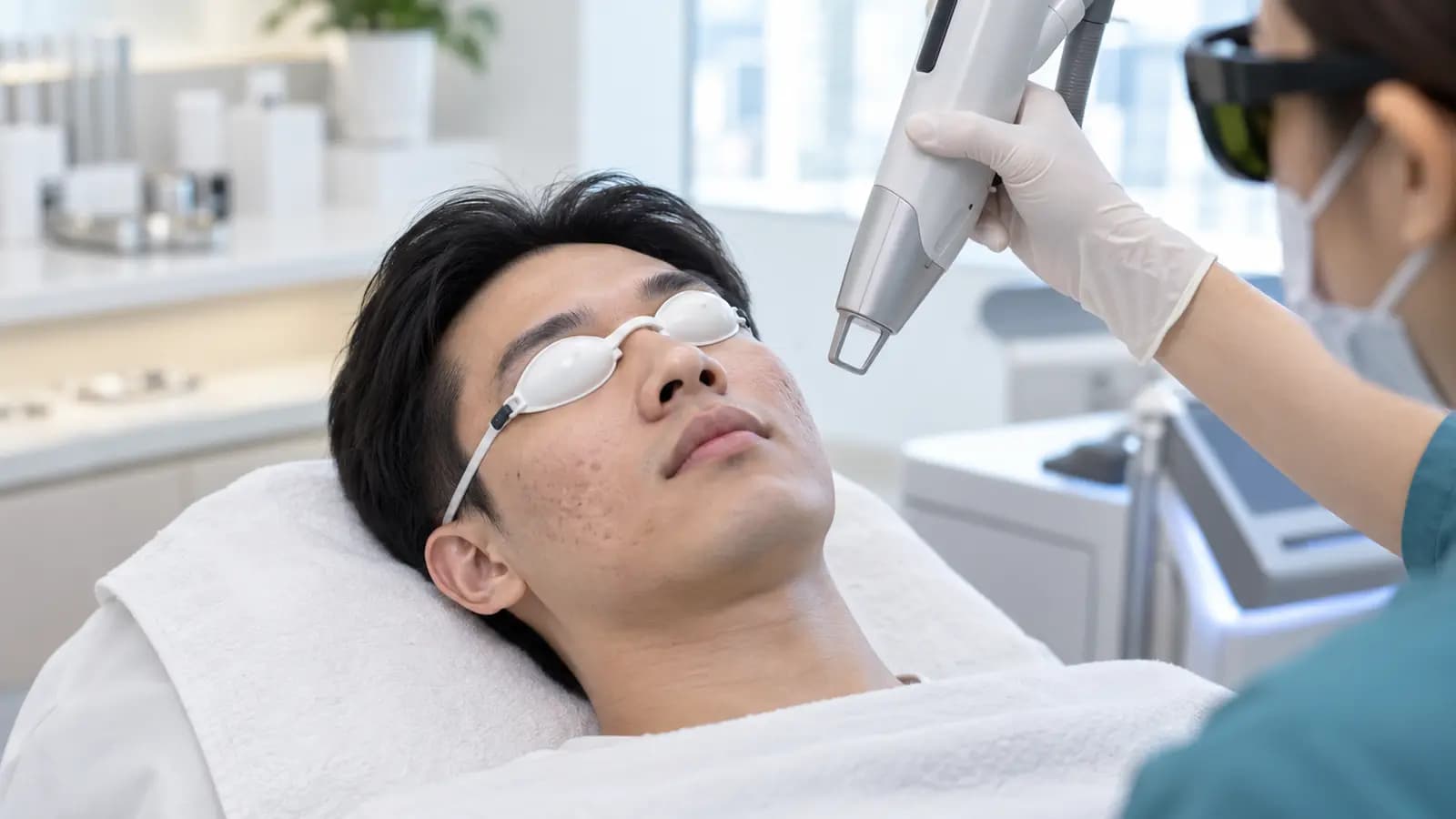

If someone tells you that pico laser and Fractional CO2 laser do the same thing but call it different names, that's not true and is the root of many patient's disappointment after choosing the wrong option. Pico laser is for breaking up pigment, dark spots, melasma, sun damage using incredibly short pulses of energy that have little impact on the surrounding skin. Fractional CO2 is an ablative laser that vaporises columns of tissue to coerce the skin into rebuilding itself; it's the stronger solution for texture and deep scarring. One breaks down colour, the other rebuilds structure, it's the real distinction, not brand preference.
Malaysian patients with both pigment and acne scarring (common in our sunny climate) often ask for one or the other, without considering that both might require different solutions.
The Mechanism, Explained
Pico laser works in picoseconds, a trillionth of a second, with a photomechanical process that fractures pigmented particles into sizes the body can easily remove without causing much thermal damage to the surrounding skin. This gives it the reputation of being gentler and having less downtime, and being a safer option for darker skin tones (Fitzpatrick IV and V), common in Malaysia.
Fractional CO2 laser is a photothermal, ablative laser that vapourises columns of tissue in a pixelated pattern (fractionated). This causes a controlled injury to the skin that stimulates an accelerated wound healing response and, consequently, more collagen production. Fractional CO2 lasers are superior to pico lasers for most textural-based concerns but have longer downtime and carry a higher risk of post-inflammatory hyperpigmentation on darker skin tones.
| Pico Laser | Fractional CO2 Laser | |
|---|---|---|
| Mechanism | Photomechanical; picoseconds; shatters pigment | Photothermal; ablative; vapourises tissue |
| Primary strength | Pigments, melanin, sun spots | Texture, deep scars, skin resurfacing |
| Effect on scars | Mild textural improvement; suited to tone and pore refinement | Stronger effect on structure; better for boxcar/rolling scars |
| Downtime | Minimal; redness dissipates within hours/day | Visible redness; lasts about a week |
| Sessions usually needed | Often 3 to 5 sessions for visibly lightened pigmentation; can be less for a glowy result | Fewer sessions overall; sometimes 1 to 3 sessions for comparable textural improvement |
| Skin tone safety | Safer across a wider range of skin tones | Some caution historically on darker skin tones |
| Typical Malaysian use case | Melasma, sun-induced pigmentation | Depressed acne scars |
Pigment Problem or Texture Problem: What Do You Actually Have?
This is the defining question for choosing which treatment to invest in. Pigment problems (melasma, sun spots) and texture problems (deep acne scarring) often occur together on the same face, but their appearance is distinct, the dark marks tend to be in their own right, on top of the more texturally scarring areas (like old acne pits or rolling skin folds).
- If the problem is brown patches or uneven, dull skin tone with no actual depressions or craters on the skin, pico laser tends to be the more relevant and downtime-friendly choice.
- If the problem is actual depressed scars with a textural irregularity (that you can feel with your fingers), fractional CO2 tends to offer better results.
- If it's genuinely both (dark marks or pigments on top of texturally scarring areas), a staged approach combining both treatments (first CO2 for structure, later pico laser for pigments) is a fairly common strategy among Malaysian clinics.
- For very mild, textural concerns without deep scarring, some pico laser clinics use a fractional pico handpiece (fractional ablative pico laser) as a middle ground solution; though this isn't the same as a regular pico toning session aimed purely at pigments.
The Malaysian Skin Consideration You Should Know About
Skin tone genuinely affects the outcome. Pico laser's non-thermal mechanism carries less risk for post-inflammatory hyperpigmentation on darker skin tones (Fitzpatrick III-V); a concern for many Malaysian patients. Fractional CO2, being an ablative (heat) laser, historically had more caution for use on darker skin tones. However, newer fractional CO2 lasers, conservative settings, careful spacing between treatments, and diligent aftercare have rendered it significantly safer than many remember from older generation lasers.
It's also important to note that generic international articles rarely account for Malaysia's climate, but both post-treatment aftercare and fractional CO2 in particular have more considerations with the local humidity and sunlight. Avoiding sun exposure is one of the leading reasons why patients get hyperpigmentation after a resurfacing procedure instead of the lightening they expected.
What Actually Happens During the Consultation
Before recommending either device, a proper consultation would need to walk through the following:
Is the primary concern one of colour or contour? How deep do the scars go and are they atrophic? What's your Fitzpatrick skin type and how has your skin reacted to laser or heat treatments before (if at all)? Do you have active breakouts or keloid tendencies or recent sun exposure that would need to be addressed before the laser sessions?
If your concerns span across pigments and acne scarring, it's important to understand what realistic outcomes can be expected before any sessions are scheduled. The before and after overview from this clinic covers what realistic pico laser results look like for melasma, pigmentation and acne scars in Malaysia; a more honest starting point than the exaggerated results online. How pico laser addresses acne related pigmentation specifically in Malaysia is a more detailed breakdown for cases closer to post-acne marks than deep scarring. If your scars turn out to be more textural than pigment-related, a doctor may guide the conversation toward a more comprehensive acne scar treatment plan instead; as the acne scars page covers the full range of options and approaches, beyond lasers.
A Few Practical Things Worth Knowing
- Pico laser results build gradually across sessions. Your skin often continues brightening for weeks after each session; which is why multiple sessions are recommended.
- Fractional CO2 tends to show more of its final results after one or two sessions, but the visible healing, peeling and redness is more involved and requires proper downtime planning.
- Combining both isn't unusual. Some patients do one CO2 session for structural repairs, then follow up with periodic pico sessions to maintain tone and brightness.
- Strict sun avoidance after either treatment is non-negotiable in Malaysia's climate. It's the difference between a successful outcome and disappointment.
- Neither treatment is a single session fix for deep, long-standing scarring or stubborn melasma. Expecting one visit to resolve either issue sets up unrealistic expectations from the start.
Frequently Asked Questions
Can pico laser fix deep acne scars on its own?
Pico laser can offer mild improvement in textural scars, but for genuinely deep atrophic scars, fractional CO2 laser or a combined approach usually achieves more meaningful results.
Is fractional CO2 laser safe for darker Malaysian skin tones?
Fractional CO2 can be, with conservative settings and diligent aftercare; but it carries a higher risk of post-inflammatory hyperpigmentation than pico laser, which is why skin type evaluation is important before treatment.
How many pico laser sessions are needed for melasma?
Melasma often requires multiple sessions (commonly 3 to 5 or more) as it's a condition that responds gradually and can also be triggered by hormonal and sun exposure factors, which need to be managed alongside treatment.
Can I do pico laser and fractional CO2 laser together?
Yes, many treatment plans use a combination of both lasers; using CO2 for structural scar improvement and pico laser afterward for tone and pigment refinement. However, sessions should be spaced by a doctor.
Which treatment has less downtime?
Pico laser has considerably less downtime (often just visible redness for a few hours or a day), compared to fractional CO2 laser (visible redness and peeling for about a week).
Does pico laser help with old acne marks that aren't true scars?
Yes, if what you're seeing is pigmentation left over from old breakouts (not actual depressions), pico laser is well-suited for fading old acne marks.
Not Sure Whether Your Concern Is Pigment or Texture?
The two often overlap on the same face, and treating the wrong concern first usually means paying for a session that doesn't make a difference. Consult with the team at Nexus Clinic KL (book a consultation) or message us on WhatsApp if you'd like to ask a few questions.