

Your Skincare Routine Might Not Be the Problem
If you have been using a high-quality moisturiser every morning and evening but your skin still looks dull, feels tight under Malaysia’s relentless air conditioning, or shows fine lines that no serum seems to fix, you are not alone. Many Malaysians spend hundreds of ringgit each month on skincare products expecting dramatic improvements, only to find their results plateau after a few weeks. The truth is, your routine may not be failing you. The problem might be that topical skincare can only go so far, and past a certain point, the skin needs hydration delivered from within.
This is the fundamental difference between a moisturiser and a skin booster injection. Both aim to improve skin hydration, but they work at entirely different levels of the skin, deliver completely different intensities of hydration, and produce results that last for very different lengths of time. Understanding how each one works makes it much easier to decide which approach your skin actually needs right now.
What a Moisturiser Actually Does
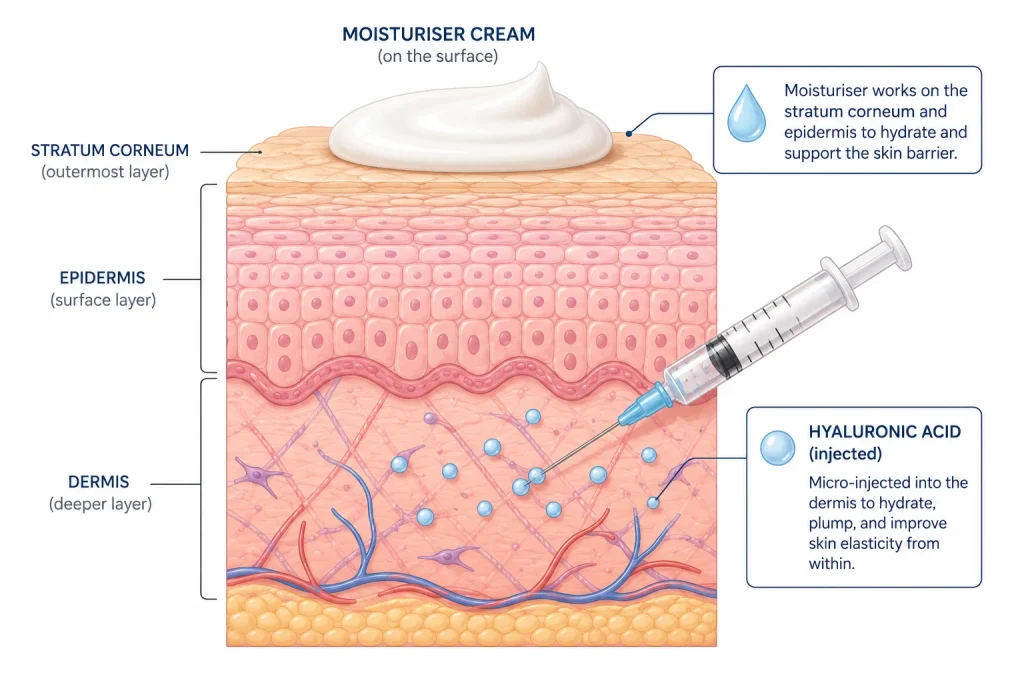
A moisturiser works on the surface of the skin, specifically at the level of the epidermis, which is the outermost layer. Depending on its formulation, a moisturiser either attracts water to the surface of the skin using ingredients called humectants, creates a physical barrier that slows down moisture loss using occlusives, or softens the skin surface using emollients. Common humectants you will find in moisturisers include hyaluronic acid, glycerin, and urea. Occlusives include petrolatum, beeswax, and dimethicone. Emollients include oils, shea butter, and fatty acids.
The important thing to understand is that the hyaluronic acid in a moisturiser does not penetrate into the deeper layers of the skin. The molecular weight of most topically applied hyaluronic acid is too large to pass through the skin barrier, which means it sits on the surface and holds moisture there rather than replenishing the dermis below. This is not a product flaw. Topical moisturisers are designed for surface-level hydration, and they do that job well. The limitation only becomes apparent when the skin’s deeper layers are depleted and surface application alone cannot address that level of dryness or skin quality decline.
Moisturisers also require daily and consistent application. The moment you stop using them regularly, the benefit disappears. There is no sustained internal change in the skin’s hydration capacity because nothing has been delivered below the epidermal barrier.
Why Hyaluronic Acid in Skincare Cannot Reach the Dermis
The skin’s outer barrier, known as the stratum corneum, is designed specifically to keep things out. This is one of the skin’s most important protective functions, but it also means that most topically applied active ingredients, including hyaluronic acid, cannot penetrate deeply enough to affect the dermis. Studies have shown that standard high-molecular-weight hyaluronic acid applied to the skin stays almost entirely on the surface. Even nano-formulated low-molecular-weight hyaluronic acid, which can penetrate slightly further, still does not reach the deep dermis where the skin’s structural support and moisture-holding capacity actually live.
This matters because the dermis is where collagen, elastin, and the skin’s natural hyaluronic acid matrix are found. As we age, the hyaluronic acid content in the dermis declines significantly. This leads to the skin losing its plumpness, bounce, and ability to retain moisture effectively. No amount of topical application can correct this kind of structural depletion because the molecules simply cannot travel that far through the skin on their own.
What Skin Booster Injections Do Differently
Skin booster injections solve the penetration problem by bypassing the skin barrier entirely. A trained aesthetic doctor uses very fine needles to micro-inject a fluid form of hyaluronic acid directly into the dermis, the exact layer where the skin’s natural hydration matrix resides. Because the product is delivered directly to where it is needed, 100 percent of the injected hyaluronic acid is available to attract and hold water at that level. There is no barrier to cross, no absorption rate to worry about, and no surface evaporation.
In Malaysia, the most established skin boosters include Profhilo, Rejuran, Newest, and Karisma, each of which works through a slightly different mechanism. Some focus on direct deep hydration, some stimulate collagen and elastin production alongside hydrating the skin, and some combine polynucleotides or other bioactive compounds to promote skin repair and regeneration. The results visible after a course of treatment, including improved skin texture, a natural glow, reduced fine lines, and better skin elasticity, come from sustained change inside the dermis rather than temporary surface coverage.
The effects of a skin booster injection last between six months and up to a year depending on the product used, the number of sessions completed, and individual metabolism. This is fundamentally different from a moisturiser, which needs to be reapplied every day to maintain its effect.
Head to Head: Skin Booster vs Moisturiser
To make the comparison clearer, consider how the two approaches differ across the factors that matter most to someone evaluating their skincare options in Malaysia.
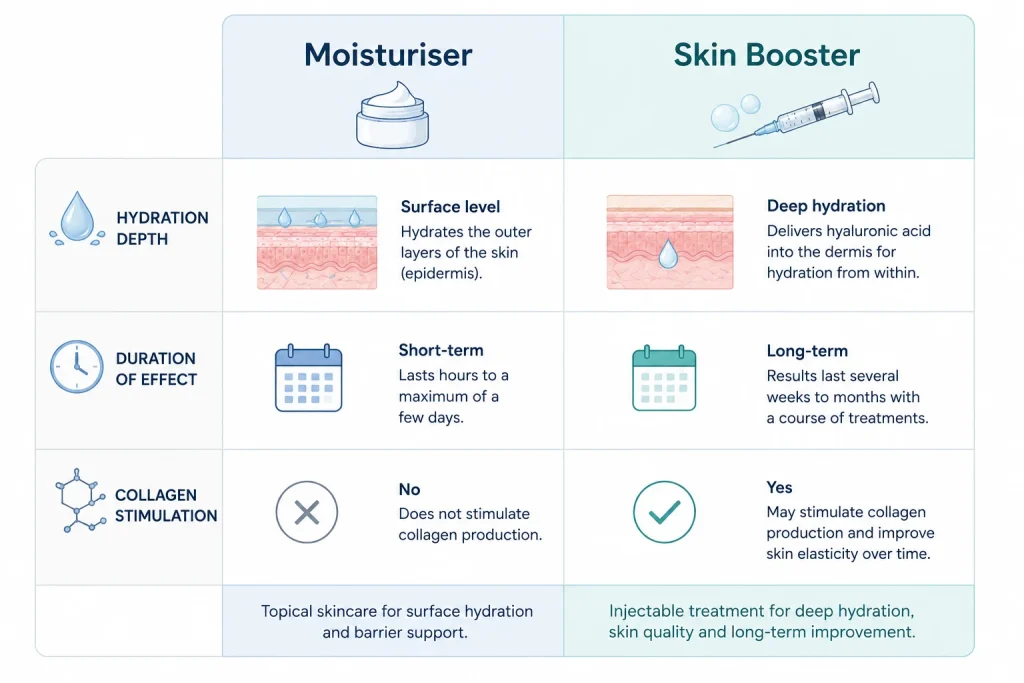
In terms of hydration depth, a moisturiser works at the epidermis and cannot meaningfully hydrate the dermis. A skin booster is injected directly into the dermis and provides sustained hydration where the skin’s structural and moisture-retaining components actually exist.
In terms of duration, a moisturiser must be applied once or twice daily to maintain its effect. A skin booster course of two to three sessions typically produces results that last six to twelve months before a maintenance session is needed.
In terms of skin quality improvement, a moisturiser can make the skin surface feel softer and temporarily look more hydrated, but it does not stimulate collagen production, improve elasticity, or address structural skin ageing. Many skin boosters actively stimulate fibroblasts to produce new collagen and elastin, which leads to measurable improvements in skin density, firmness, and texture over time.
In terms of cost per month when amortised, a quality moisturiser used twice daily might cost between RM80 and RM300 per month depending on the brand. A course of two Profhilo sessions at roughly RM2,500 each, giving results for six months, works out to approximately RM833 per month over the duration of those results. The monthly cost difference narrows significantly when the depth and duration of the improvement are taken into account.
Who Should Stick with a Moisturiser vs Who Should Consider Injections
A moisturiser is the right choice for someone in their early to mid-twenties who has healthy skin hydration levels and just wants to maintain a good moisture barrier, protect against environmental stress, and support their overall skincare routine. For this person, the skin’s natural hyaluronic acid matrix in the dermis is still intact and functioning well, which means topical support is genuinely sufficient.
A skin booster injection becomes worth considering when the skin shows signs that surface hydration is no longer keeping up with the skin’s needs. These signs include persistent dullness that does not respond to serums, a rough or crepe-like texture, fine lines that appear primarily due to dehydration rather than volume loss, a lack of the natural bounce or spring that healthy skin has, and an overall tired or flat appearance despite a consistent skincare routine. This is typically more common in people over thirty, though earlier onset is common in Malaysia due to high UV exposure, frequent air conditioning, and the combination of outdoor heat and dehydrating indoor environments.
The Malaysian Skin Context: Why Injections Make Particular Sense Here
Malaysia’s climate creates a paradox that affects many people’s skin. The outdoor heat and humidity can make skin feel oily and well-hydrated on the surface. However, the hours spent in heavily air-conditioned offices, malls, and cars consistently strip moisture from the skin. The rapid movement between hot, humid outdoor air and cold, dry indoor air stresses the skin barrier repeatedly throughout the day. Add to this Malaysia’s high UV index, which accelerates skin ageing and degrades the skin’s hyaluronic acid matrix faster than in temperate climates, and the conditions for premature deep dermal dehydration are significant.
This means that Malaysians may reach the point where topical skincare is no longer sufficient earlier than people living in more temperate countries. The skin might look oily or feel fine on the surface while the dermis is actually significantly depleted. A skin booster injection addresses this hidden layer of dehydration in a way that no amount of topical product can match.
Can You Combine Both?
Yes, and combining both is actually the ideal approach for most people who choose injectable skin boosters. The injection restores deep dermal hydration and stimulates the skin’s own repair mechanisms, while a good daily moisturiser protects the skin barrier, reduces transepidermal water loss, and supports the skin’s recovery between treatment sessions. Think of the moisturiser as maintaining the surface while the skin booster works on the deeper architecture. Many aesthetic doctors in Malaysia recommend continuing a basic moisturising routine as part of aftercare following skin booster treatments.
If you are unsure whether your skin concerns sit at the surface level or the dermal level, a skin booster consultation at Nexus Clinic can help identify the right starting point. A trained doctor can assess your skin quality, discuss your goals, and recommend whether topical care, injectable treatment, or a combination of both will give you the results you are looking for.
The Bottom Line
A moisturiser and a skin booster injection are not competing products. They work at different levels of the skin and serve different purposes. For mild surface dryness and barrier maintenance, a good daily moisturiser is genuinely effective. For persistent dullness, loss of elasticity, fine lines from dehydration, and the kind of skin fatigue that topical products cannot shift, a skin booster injection delivers hydration directly where it needs to go and produces results that last far longer than anything applied to the surface. In Malaysia’s climate, where the skin is under constant stress from UV exposure, air conditioning, and heat, the case for injectable hydration is particularly strong for anyone over thirty whose skin has stopped responding meaningfully to topical skincare alone.