
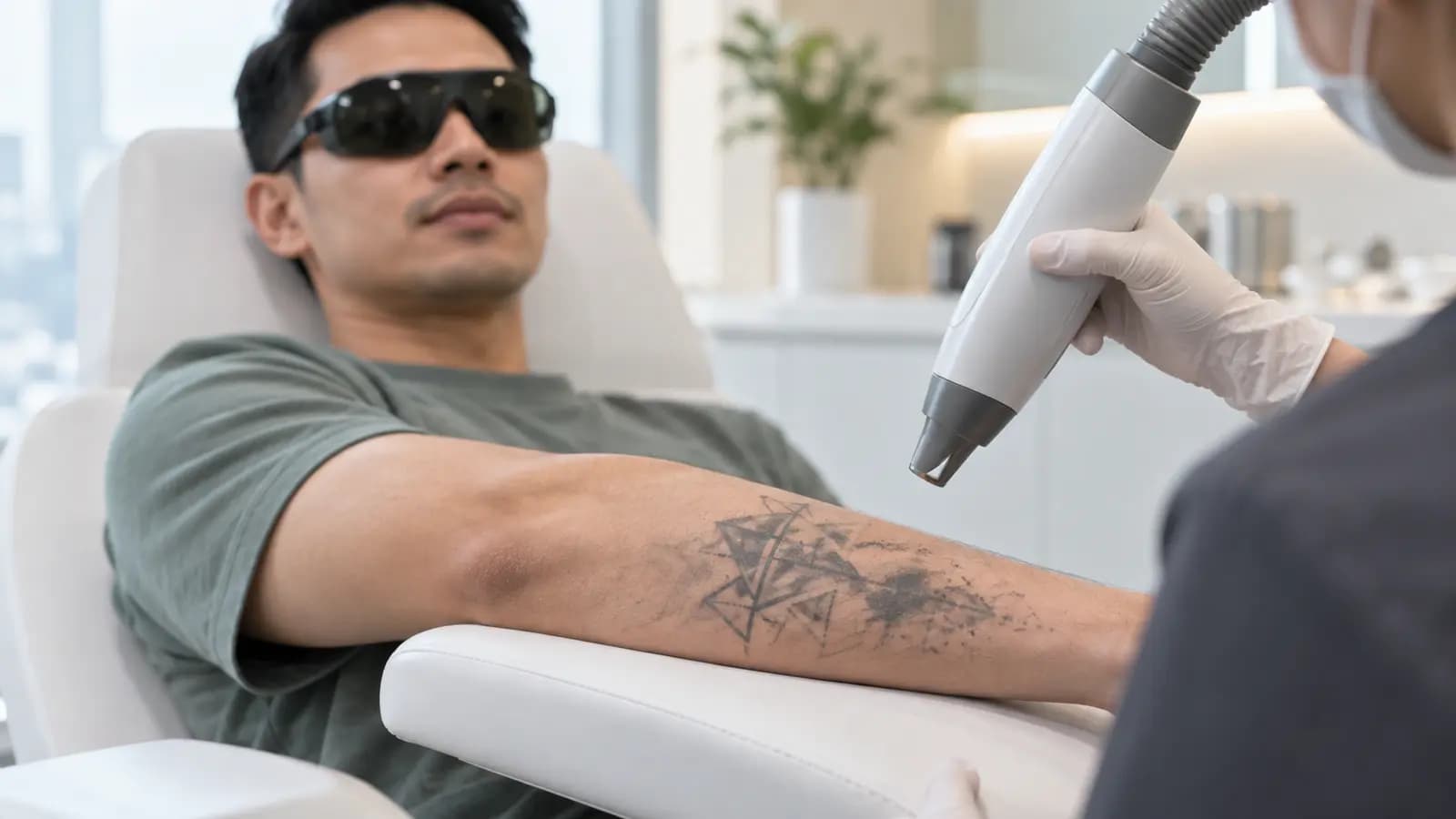

Tattoos typically require anywhere between 6-12 sessions for removal, however, this statistic is somewhat misleading as a black outline is hardly comparable to a thick multicolour sleeve. Instead, a more accurate assessment of your own situation is achieved by scoring six particular factors related to your tattoo and not another individual's tattoo, which is why the Kirby-Desai scale was created, and why it's helpful to understand it before attempting to estimate the number of tattoo removal sessions you may need.
Why “It Depends” Is The Most Honest Answer One Can Give
A tattoo removal study conducted across a hundred patients who underwent removal procedures between 2013 and 2017 revealed that the number of sessions varied between 3 and 20 with an average of 10. This variance is explained by the considerable differences between tattoos in terms of their colours, density, placement, and individual variations in the body's response to laser energy absorption and processing. With that said, two seemingly similar tattoos can differ substantially in terms of the number of sessions required due to the following reasons:
- The amount and type of ink used
- Your skin type
- Placement and size
- Complications with the skin
- Layering or cover-ups
- Ink colours
A scale created by dermatologists Kirby and Desai allows for calculating a score that roughly estimates the number of sessions tattoo removal may take for a given tattoo.
The Six Factors That Affect The Number Of Tattoo Removal Sessions
| Factor | Description |
|---|---|
| Skin type | Determines the amount of melanin produced by your skin |
| Location | Determines the distance from the heart |
| Ink colours | Determines the wavelength absorption rate |
| Amount of ink | Influences the density of the tattoo |
| Scarring | Determines the additional complications with the skin |
| Layering or cover-ups | Determines whether there is more than one tattoo |
Each factor is scored on a scale from 1 to 5 with 1 being the lowest and 5 being the highest. Your overall score provides an estimate as follows:
| Score | Session Estimate | Notes |
|---|---|---|
| 3-4 | 1-4 sessions | Easily removable tattoos |
| 5-7 | 5-10 sessions | Medium-density tattoos |
| 8-10 | 10+ sessions | High-density tattoos |
| 11-14 | 10+ sessions | Tattoos requiring heavy fading |
| 15-17 | Potentially un-removable tattoos | Completely faded tattoos may not be an option |
What This Means For Malaysian Skin
As a rule of thumb, Malaysian skin tends to be within the 3-5 range on the Fitzpatrick scale. This has two primary implications for tattoo removal. First, lasers utilized by clinics in Malaysia operate on a slightly lower power to prevent additional darkening of the skin after removal sessions as the laser light gets absorbed by melanin in the skin. Second, sessions are generally spaced out further to allow Malaysian patients' bodies to process the tattoo pigment at a slightly slower rate than observed in patients with lighter skin. As such, patients with dark skin may require additional sessions over a longer time period compared to their lighter-skinned counterparts with similar tattoos. This is also the reason why picosecond laser technology has become more popular in tattoo removal compared to traditional QS laser technology.
A more detailed explanation of the differences between the two technologies, as well as an overview of the conditions for which each is more suitable can be found in the pico laser versus Q-switch for tattoo removal in KL article, which may be of particular interest to patients considering tattoo removal in Malaysia.
Why Sessions Cannot Be Spaced Closer Than Every 8 Weeks
The 8-week gap between sessions exists for a reason. After laser tattoo removal, the broken-up ink particles need to be fully processed and expelled from the body by the lymphatic system before the next session can be performed.
It is therefore pointless to attempt to schedule additional sessions prematurely as they will not achieve any additional effects. The main reason why tattoos on the torso and upper body generally fade quicker is due to their proximity to the heart and the associated improvements in lymphatic drainage. By contrast, tattoos on extremities tend to take longer to fully fade due to slower lymphatic drainage, irrespective of ink density or colours.
A Sample Breakdown For Estimating Your Own Tattoo Removal Sessions
Based on the information provided above, it is possible to estimate the approximate number of sessions needed for tattoo removal individually for each tattoo. For example:
A small tattoo of a single colour, mostly black ink, on light skin and on a well-drained area like the upper body or back falls within the lower range of 4-6 sessions. A medium tattoo with some colours, on moderately dark skin and on the upper body or back falls within the middle range and requires between 6-10 sessions.
A thick multicolour tattoo, done professionally and containing a combination of yellow, green, and light blue ink requires heavy fading and falls within the top range, necessitating more than 10 sessions for removal. Any tattoo that covers up an old tattoo is effectively two tattoos, requiring significantly more sessions for removal compared to a single tattoo. Finally, a tattoo on the feet, hands, or ankles takes significantly longer to fade due to poor lymphatic drainage.
The Importance Of Post-Session Care In Between Tattoo Removal Sessions
While laser energy itself plays the primary role in tattoo removal, the skin's response to it is vitally important in determining how much progress is made with each session. After-session care and lymphatic drainage can make a noticeable difference in terms of the skin healing between sessions. Patients may wish to explore additional treatments and aftercare options to assist in skin recovery, reduce the side effects of sessions, and help the skin better process the ink for faster removal. More information on this topic can be found in the article on combining pico laser with other treatments for better skin recovery post tattoo removal.
What Is Assessed During A Tattoo Removal Consultation At Nexus Clinic?
Prior to providing any patient with an estimate of the number of tattoo removal sessions that they may require, a qualified specialist will need to evaluate your tattoo in detail. This assessment involves visually inspecting the tattoo's ink density and colours as well as estimating the tattoo's size and location. In addition, your skin type will need to be estimated using the Fitzpatrick scale and the condition of your skin examined for any complications. If applicable, relevant questions concerning your tattoo's history will be asked, such as whether it was professionally done, is a cover-up for an older tattoo, and whether it has been touched up over time. A thorough initial assessment is essential in providing a realistic estimate, and an overview of this process can be found on the tattoo removal page of our website.
A Few Additional Notes Prior To Booking An Appointment
Your tattoo may not be fully removable, depending on your skin type and the colours of the tattoo. It is important to understand that while laser tattoo removal is generally effective, there are certain colours that respond to laser energy less consistently than others, and some tattoos may only be substantially faded. A responsible clinic will provide you with an honest assessment of your tattoo's chances of being fully removed. Similarly, keep in mind that while additional sessions can be scheduled within the 8-week window following your last session, they will not be beneficial if your body has not had enough time to process the broken-up tattoo ink.
It is important to recognize that a cover-up tattoo is effectively two tattoos: one for the new tattoo and one for the old tattoo that is being covered up. In many cases, it may be considerably more expensive and time-consuming to remove a cover-up tattoo compared to getting a tattoo removed. Furthermore, it is advisable to avoid excessive sunlight exposure on the tattoo following a session, as it can interfere with the body's ability to remove the tattoo pigment, particularly during sunny weather, which is common in Malaysia.
When considering laser tattoo removal services, it is crucial to bear in mind that the lowest number of sessions may not always be the best option. Be wary of clinics that advertise exceptionally low session numbers without providing a proper assessment of your tattoo, as they may not be entirely truthful about their capabilities and expectations of the removal process.
Frequently Asked Questions
What is the average number of tattoo removal sessions in Malaysia?
Most tattoos in Malaysia require between 6-12 sessions for removal.
Why do dark skin tones sometimes require more sessions for tattoo removal?
Darker skin tones tend to absorb more laser light, and practitioners have to utilise lower settings to avoid damaging the skin, prolonging the removal process.
How far apart should tattoo removal sessions be scheduled?
Tattoo removal sessions should be scheduled around every 8 weeks to allow the body sufficient time to process the broken-up tattoo ink.
Can all tattoos be fully removed?
Unfortunately, not all tattoos can be fully removed, as some colours respond to laser energy less consistently than others. Some tattoos may only be substantially faded.
Do tattoos that cover up an old tattoo require more sessions for removal?
Yes, tattoos that cover up an old tattoo effectively require twice the effort to be removed, as there are two tattoos that need to be processed.
Is pico laser faster than older laser technology for tattoo removal?
Pico laser's picosecond pulses are significantly shorter than older QS laser technology, allowing for greater control and more efficient processing of the tattoo pigment. This means that tattoo removal with pico laser technology can often be completed in fewer sessions than with older QS laser technology.
Now that you know how many sessions it takes to remove a tattoo, learn more about tattoo removal in Malaysia or contact our clinic on WhatsApp to schedule a consultation.