
Treat Alopecia Areata in Malaysia Restore Hair & Confidence
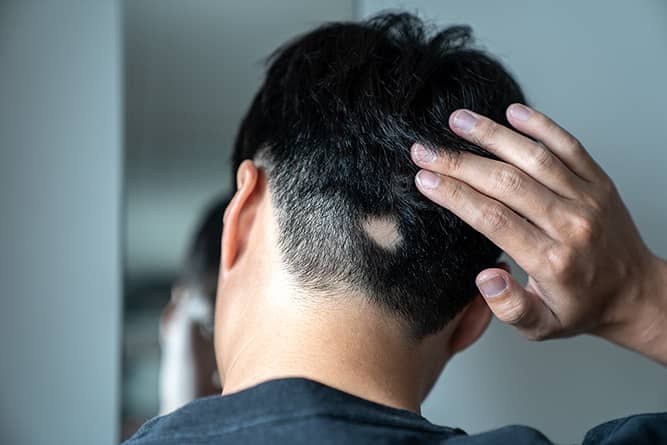
Sudden bald patches are not normal hair loss. You may wake up one day and notice a round patch on your scalp. No warning. No slow thinning. Just missing hair.
Alopecia areata is not ordinary hair thinning. It is a condition where the immune system attacks the hair follicles. The hair falls out in patches, but the follicle may still be alive. That means regrowth may still be possible with the right treatment. At Nexus Clinic Kuala Lumpur, treatment starts with diagnosis first. We check whether your hair loss is really alopecia areata, scalp inflammation, fungal infection, stress-related shedding, male or female pattern hair loss, or another condition. The goal is simple. Find the cause. Calm the scalp. Support regrowth. Avoid guessing with the wrong creams.
Important Clinical Note
Not all hair loss is alopecia areata. Hydrocortisone cream and other steroid-based treatments may help in selected inflammatory scalp conditions, but they are not general hair growth products. Always confirm the diagnosis before starting treatment.
✨ Alopecia Areata Treatment
Diagnosis first • Targeted care
Alopecia Areata Treatment Overview
Everything you need to know at a glance.
| Treatment Area | Details |
|---|---|
| Condition | Alopecia areata, patchy hair loss, bald spots |
| Common Signs | Round bald patches, sudden hair fall, scalp patches, beard patches |
| Main Cause | Immune-related inflammation around hair follicles |
| Treatment Options | Corticosteroid injections, topical steroid creams, hydrocortisone-based care, PRP, minoxidil support |
| Session Time | 10 to 30 minutes, depending on treatment |
| Downtime | Minimal |
| Results Timeline | Regrowth may appear within 6 to 12 weeks in responsive cases |
| Best For | Early or limited patchy hair loss |
| Clinic Approach | Diagnosis first, then personalised treatment |
Treatment Area
Condition
Details
Alopecia areata, patchy hair loss, bald spots
Treatment Area
Common Signs
Treatment Area
Main Cause
Treatment Area
Treatment Options
Treatment Area
Session Time
Treatment Area
Downtime
Treatment Area
Results Timeline
Treatment Area
Best For
Treatment Area
Clinic Approach
What Is Alopecia Areata?
Alopecia areata is a type of hair loss where the body's immune system attacks the hair follicles. It usually appears as round or oval bald patches on the scalp. Some patients notice one small patch. Others may develop multiple patches.
It can also affect the beard area, eyebrows, eyelashes, and other hair-bearing areas. The hair can fall out quickly. This is why many patients feel shocked when they first notice it.
The good news is that alopecia areata does not always mean permanent hair loss. In many cases, the follicle is still present. Treatment aims to reduce inflammation and help the follicle restart growth.
The Patchy Hair Loss Problem Most Patients Get Wrong
Most patients think every type of hair loss needs the same treatment. That is not true.
- Minoxidil may help pattern thinning.
- PRP may support weak follicles.
- Hair transplant may help permanent bald areas.
- But alopecia areata needs a different plan.
If the immune system is attacking the follicle, simply applying ordinary hair oil or shampoo will not solve the problem. And if the bald patch is caused by fungus, infection or scarring alopecia, steroid cream may make the problem worse.
This is why diagnosis matters. At Nexus Clinic KL, we first identify what type of hair loss you have before recommending any treatment.
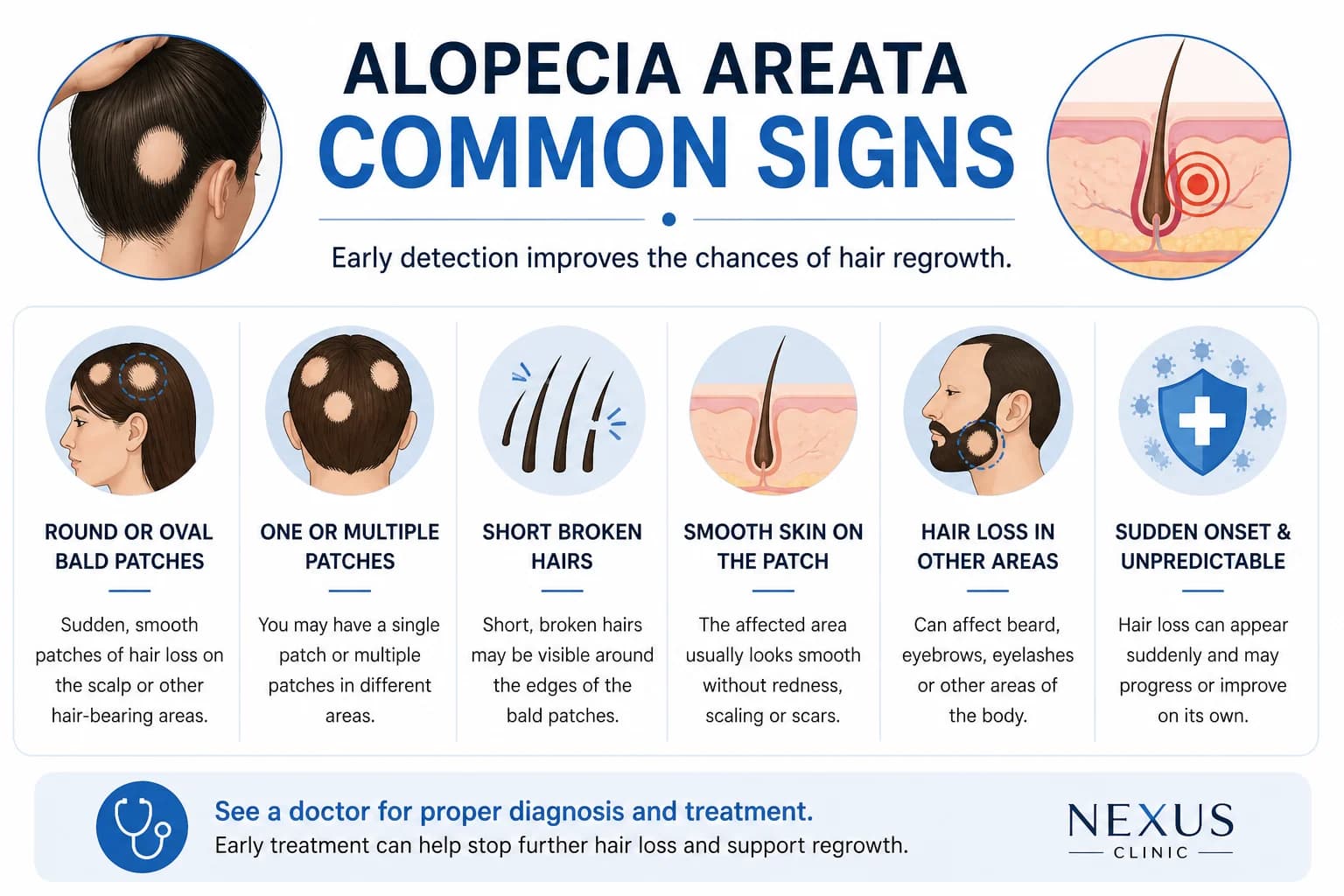
Common Signs of Alopecia Areata
Some patients also notice mild itching or tingling before the hair falls out, but many have no symptoms at all.
Who Benefits Most from Alopecia Areata Treatment?
The earlier the condition is assessed, the easier it is to choose the right treatment path.
Alopecia Areata Treatment Options at Nexus Clinic KL
There is no single treatment that works for every patient. Your treatment depends on the size of the patch, how long it has been present, whether the condition is active, and whether there is scalp inflammation.
1. Corticosteroid Injections for Alopecia Areata
Corticosteroid injections are commonly used for small patches of alopecia areata. The medicine is placed directly into the affected bald patch. The aim is to calm the immune activity around the follicle and help hair regrowth restart.
This option is usually considered for small bald patches, recent alopecia areata, localised scalp patches, beard patch hair loss, and patients who need targeted treatment. Treatment may need to be repeated every few weeks depending on response.
2. Hydrocortisone Cream for Hair Loss: When It Helps
Hydrocortisone cream is not a hair growth cream. This is important.
Hydrocortisone is a mild steroid cream. It may help when hair loss is linked to inflammation, irritation, eczema-like scalp problems or mild immune-related activity. It does not work like minoxidil. It does not directly force hair growth. It does not treat every type of hair loss.
Hydrocortisone-based treatment may be considered when the scalp is red or inflamed, there is itching with hair loss, the bald patch has irritation around it, a doctor suspects inflammatory scalp activity, or the patient needs a mild topical steroid option.
But it should not be used blindly. If the scalp problem is fungal, infected or wrongly diagnosed, steroid cream can hide symptoms and delay proper treatment.
That is why Nexus Clinic recommends doctor-led assessment before using hydrocortisone cream for hair loss.
3. Stronger Topical Steroid Treatment
Some patients need stronger topical steroid treatment than hydrocortisone. This depends on severity of alopecia areata, location of the bald patch, scalp sensitivity, age of the patient, previous treatment history, and risk of side effects.
The doctor will decide the correct strength, amount and duration. Steroid creams should not be used as a daily long-term product unless instructed.
4. PRP Hair Treatment Support
PRP hair treatment may be used alongside other treatments in selected hair loss cases. PRP uses growth factors from your own blood to support weak follicles and improve scalp healing. It is not the same as steroid treatment, but it may help improve the scalp environment.
PRP may be useful when alopecia areata overlaps with general hair thinning or weak follicle activity.
Learn more about PRP hair treatment in Malaysia →5. Minoxidil Support
Minoxidil may be recommended in some cases to support regrowth. It is commonly used for pattern hair loss, but doctors may also use it as support in selected alopecia areata cases.
Minoxidil does not treat the immune cause directly. It supports the growth phase of hair.
Learn more about minoxidil treatment in Malaysia →Hydrocortisone Cream vs Minoxidil vs PRP for Hair Loss
Understanding the differences helps you choose the right treatment path
| Treatment | Best For | How It Works | Limitation |
|---|---|---|---|
| Hydrocortisone Cream | Mild inflammation, irritation, selected scalp conditions | Reduces inflammation | Not a direct hair growth product |
| Corticosteroid Injection | Small alopecia areata patches | Calms immune activity around follicles | Needs doctor-administered treatment |
| Minoxidil | Pattern thinning and growth support | Helps prolong hair growth phase | Does not treat immune attack |
| PRP Hair Treatment | Weak follicles, thinning support, scalp recovery | Uses growth factors to support follicles | May need multiple sessions |
| Hair Transplant | Permanent bald areas | Moves hair follicles surgically | Not suitable for active alopecia patches |
Treatment
Hydrocortisone Cream
Best For
Mild inflammation, irritation, selected scalp conditions
How It Works
Reduces inflammation
Limitation
Not a direct hair growth product
Treatment
Corticosteroid Injection
Treatment
Minoxidil
Treatment
PRP Hair Treatment
Treatment
Hair Transplant
Why Diagnosis Comes Before Cream
A hair loss cream can only work if it matches the cause. That is why many people waste months trying the wrong product.
• A smooth bald patch may be alopecia areata.
• An itchy patch may be dermatitis.
• A flaky patch may be fungal.
• A widening part line may be female pattern hair loss.
• A receding hairline may be male pattern baldness.
• Heavy shedding may be stress, hormones, iron deficiency or illness.
They all need different treatment.
At Nexus Clinic KL, we do not treat every hair loss case the same way. We check the pattern, scalp condition, symptoms and history before recommending treatment.
Alopecia Areata vs Other Hair Loss Types
Understanding the differences helps you choose the right treatment path
| Hair Loss Type | Appearance | Common Cause | Best Treatment Direction |
|---|---|---|---|
| Alopecia Areata | Round bald patches | Immune activity | Corticosteroid treatment, topical care, support therapy |
| Male Pattern Hair Loss | Receding hairline, crown thinning | Genetics and hormones | Minoxidil, finasteride, PRP, transplant |
| Female Pattern Hair Loss | Widening part line, diffuse thinning | Hormones, genetics, age | Minoxidil, PRP, medical evaluation |
| Telogen Effluvium | Sudden shedding all over | Stress, illness, diet, hormones | Treat trigger, nutrition, scalp support |
| Fungal Scalp Infection | Flaking, itching, broken hairs | Infection | Antifungal treatment |
| Scarring Alopecia | Permanent patches, shiny scalp | Inflammatory damage | Early medical control |
Hair Loss Type
Alopecia Areata
Appearance
Round bald patches
Common Cause
Immune activity
Best Treatment Direction
Corticosteroid treatment, topical care, support therapy
Hair Loss Type
Male Pattern Hair Loss
Hair Loss Type
Female Pattern Hair Loss
Hair Loss Type
Telogen Effluvium
Hair Loss Type
Fungal Scalp Infection
Hair Loss Type
Scarring Alopecia
Why Choose Nexus Clinic Kuala Lumpur?
There are many hair loss treatments in Malaysia. The problem is not lack of options. The problem is choosing the right one.
At Nexus Clinic KL, your treatment is planned after proper assessment. We focus on finding the cause of hair loss before recommending creams, injections or advanced treatments.
The Alopecia Areata Treatment Process
Scalp and Hair Assessment
The doctor checks your scalp, bald patches, hair density, inflammation and symptoms.
Diagnosis and Treatment Planning
Your hair loss type is identified. The doctor explains which treatment options are suitable.
Personalised Treatment
May include injections, creams, PRP, minoxidil or combination care.
Progress Review
Your response is monitored, and treatment is adjusted if needed.
How Long Does Alopecia Areata Take to Regrow?
Hair regrowth is different for every patient.
Some patients see early regrowth within a few weeks. Others may need several months. In responsive cases treated with corticosteroid injections, regrowth may appear within around 3 months.
Results depend on:
Alopecia areata can also return after improvement. That is why follow-up care is important.
Alopecia Areata Treatment Price in Malaysia
The cost depends on the treatment used and the number of sessions required. A proper quote can only be given after checking the scalp and confirming the cause of hair loss.
| Treatment Option | Estimated Pricing Note |
|---|---|
| Hair Loss Consultation | Depends on doctor assessment |
| Hydrocortisone or Topical Cream | Depends on prescription and product type |
| Corticosteroid Injection | Depends on patch size and number of areas |
| PRP Hair Treatment | Depends on package and sessions |
| Combination Treatment | Depends on diagnosis and plan |
Treatment Option
Hair Loss Consultation
Treatment Option
Hydrocortisone or Topical Cream
Treatment Option
Corticosteroid Injection
Treatment Option
PRP Hair Treatment
Treatment Option
Combination Treatment
Side Effects and Safety
Steroid-based treatments are useful when prescribed correctly, but they must be used carefully.
Possible Side Effects
- • Mild redness
- • Temporary tenderness
- • Skin thinning if overused
- • Scalp irritation
- • Small dents in the skin after injection
- • Colour change in treated area
- • Worsening infection if diagnosis is wrong
Safety Note
Most risks can be reduced when treatment is done under medical guidance. Never use steroid creams without a proper diagnosis, as they can mask underlying conditions and delay appropriate treatment.
Aftercare Instructions
Frequently Asked Questions
The best treatment depends on the size, location and activity of the bald patch. Small patches are often treated with corticosteroid injections or topical steroid treatment. Some patients may also benefit from PRP or minoxidil support. Nexus Clinic KL offers doctor-led assessment to determine the most suitable approach for your specific condition.
Hydrocortisone cream is not a direct hair growth product. It may help reduce inflammation in selected scalp conditions, but it does not work like minoxidil. It should only be used when the cause of hair loss is suitable for steroid-based treatment. Using hydrocortisone without proper diagnosis can delay appropriate care.
It may help in mild or selected cases, but many alopecia areata patients need stronger treatment such as corticosteroid injections or prescription-strength topical therapy. A doctor should assess the patch first before any steroid-based treatment is started.
Round bald patches are commonly linked to alopecia areata, but they can also be caused by fungal infection, inflammation or scarring hair loss. Diagnosis is important before starting treatment to avoid using the wrong creams or delaying proper care.
Alopecia areata can improve, but it may come back. Treatment aims to control immune activity, support regrowth and reduce the risk of worsening patches. Regular follow-up and early intervention when new patches appear offer the best long-term outcome.
Some patients see early regrowth within weeks. In responsive cases, visible regrowth may appear within 6 to 12 weeks, but results vary. Factors affecting regrowth include patch size, duration of hair loss, and individual immune response.
Most patients tolerate them well. The injections are small and placed directly into the bald patch. Mild discomfort or tenderness may happen temporarily. The procedure typically takes 10 to 15 minutes depending on the number and size of patches.
Yes, it can spread in some patients. Early assessment is important, especially if new patches are appearing. Prompt treatment of active patches may help limit spread and improve regrowth potential.
Stress may trigger or worsen alopecia areata in some people, but it is not the only cause. It is mainly linked to immune activity around the hair follicles. Other factors include genetics and underlying autoimmune conditions.
PRP may support scalp healing and hair regrowth in selected cases, but it is not always the first treatment for active alopecia areata. It may be used as part of a combination plan alongside steroid-based treatment for patients with overlapping thinning concerns.
Only under medical guidance. Minoxidil and steroid creams work differently, and using them together depends on the diagnosis and scalp condition. A doctor should assess your scalp before combining these treatments.
You should see a doctor if you notice sudden bald patches, spreading hair loss, itchy or inflamed scalp, beard patches, eyebrow hair loss or no improvement after trying over-the-counter products. Early assessment offers the best chance for regrowth.
Book Alopecia Areata Consultation at Nexus Clinic Kuala Lumpur
Do not guess with hair loss creams. A bald patch needs proper diagnosis first. Hydrocortisone cream may help in selected inflammatory cases, but it is not the answer for every type of hair loss. The right treatment depends on what is happening under the scalp.
At Nexus Clinic KL, we assess your hair loss, identify the cause and recommend a treatment plan built around your condition.
Located at Wisma UOA II, Jalan Pinang, KLCC • Serving patients across Kuala Lumpur and Malaysia