 Ozempic Treatment for Weight Loss
Can Semaglutide Be Linked to Hair Loss? Causes and What May Help
5 min read


Medically reviewed by Dr. Ashvinia Bala, MBBS (AIMST University), MMC Registration No. 82489 | Last reviewed:
Hair thinning and hair loss are often used interchangeably, but thinning tends to occur before noticeable areas of baldness or recession develop. Recognising hair thinning and treating it in time is critically important, as the active follicles that remain on the scalp can often still be saved with the appropriate therapy.
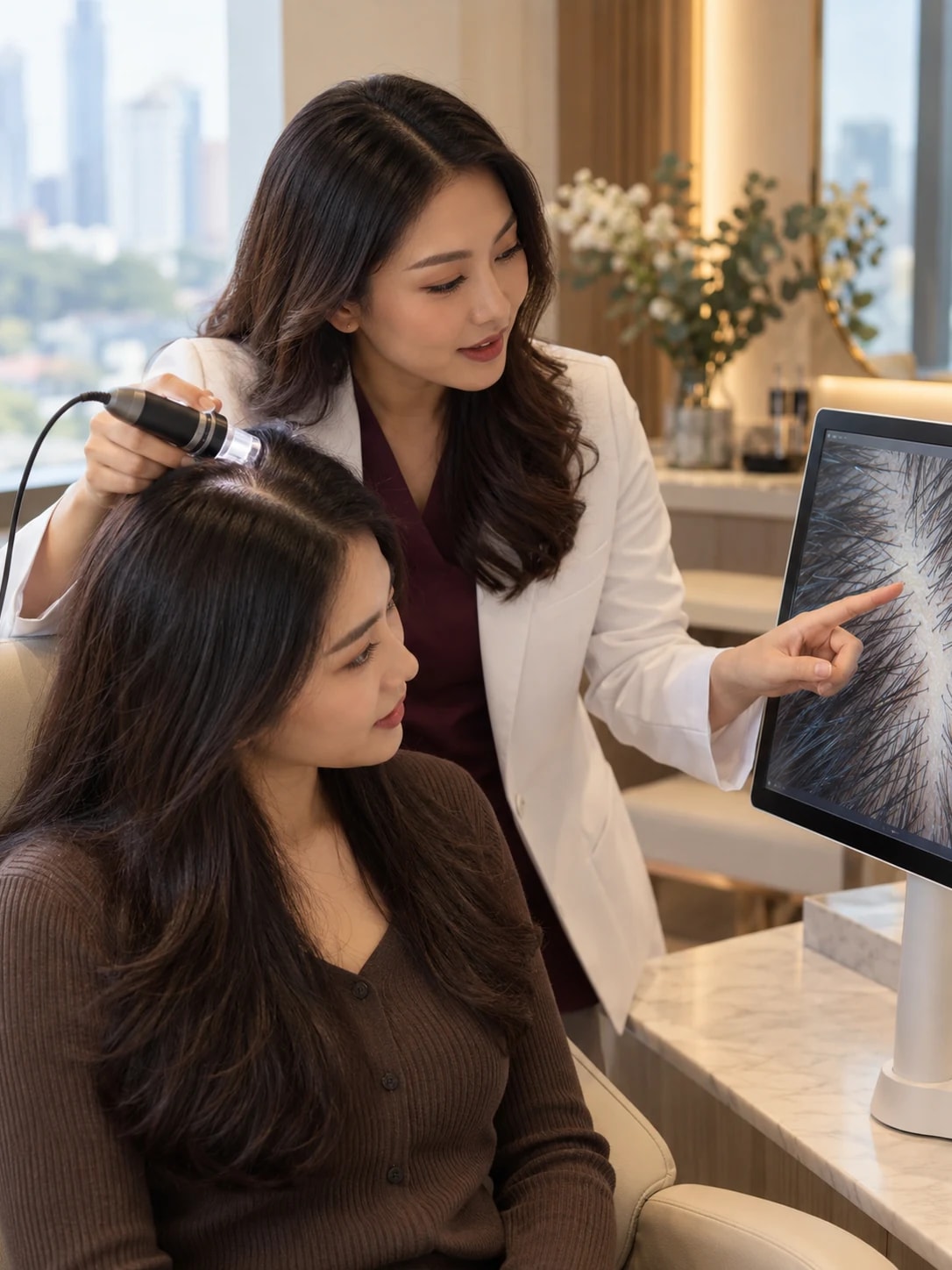
Catch it early
While follicles still respond
The temple and frontal hairline area behaves differently from the crown in terms of DHT sensitivity and treatment response, which is why a receding hairline sometimes needs a slightly different approach than general thinning elsewhere on the scalp.
Clinical Note
The hairline and temple region often shows the earliest signs of androgenetic alopecia, sometimes years before crown thinning becomes noticeable. Early intervention in this specific zone tends to preserve more of the original hairline shape than treatment started later.
The similarity between these conditions exists on a continuum, but the treatment options and timelines differ.
| Feature | Hair Thinning | Advanced Hair Loss |
|---|---|---|
| Follicle status | Weakened, still active | Often dormant or non-functional |
| Visual presentation | Reduced density, thinner strands | Visible bald patches or recession |
| Treatment response | Generally strong | Often limited without surgical intervention |
| Urgency to act | Relatively high, window narrows over time | Requires different treatment category |
Feature
Follicle status
Hair Thinning
Weakened, still active
Advanced Hair Loss
Often dormant or non-functional
Feature
Visual presentation
Feature
Treatment response
Feature
Urgency to act
Hair thinning tends to be the precursor to more advanced hair loss. If it occurs due to a genetic condition or one that is not successfully treated, it will usually progress over months or years into visibly apparent baldness rather than remaining the same.
Hair thinning is rarely caused by a single factor, and treatment will only be successful if the source is properly identified and addressed.
Hair thinning can have numerous different causes, and treatment will not be effective unless the source is properly identified. A trichoscopy examination to assess follicle status and a blood test to identify any hormonal problems are therefore usually recommended before a treatment plan can be developed.
Patients whose blood tests suggest a hormonal imbalance, particularly women with irregular cycles who also have thinning hair, may benefit from a broader hormonal evaluation before settling on a hair-specific treatment plan, as addressing this issue can be more influential than topical or injected therapies.
The active follicles that remain in regions of thinning hair tend to respond to treatment more quickly and effectively than those further along the continuum.
| Treatment | Description | Recommended Duration |
|---|---|---|
| Minoxidil | Increases blood circulation and prolongs the growth phase of hair | 3 to 6 months |
| PRP Hair Treatment | Growth factors stimulate weakened follicles to restart growth | 3 to 6 months, full course of treatments |
| Finasteride (men) | Prevents DHT production, which stops further miniaturisation of follicles | 3 to 6 months slowing, 12 to 24 months maximum benefit |
| Scalp Mesotherapy | Directly delivers nutrients to follicles | 3 to 6 months, often combined with PRP |
| Low-Level Laser Therapy | Excites cellular energy in follicles to promote growth | Ongoing sessions |
| Nutritional correction | Addresses any deficiency that contributed to thinning | Varies with severity |
Treatment
Minoxidil
Description
Increases blood circulation and prolongs the growth phase of hair
Recommended Duration
3 to 6 months
Treatment
PRP Hair Treatment
Treatment
Finasteride (men)
Treatment
Scalp Mesotherapy
Treatment
Low-Level Laser Therapy
Treatment
Nutritional correction
Minoxidil is generally recommended as the first-line treatment for diffuse thinning, as it is independent of the cause and has extensive clinical backing. PRP hair treatment is often used as an adjunct to stimulate follicles that are still active but not producing hair at the expected rate, while finasteride is frequently recommended for men with genetic thinning as it directly counteracts the hormone responsible for the condition.
Mesotherapy tends to be recommended for patients whose thinning is partially influenced by environmental or nutritional factors, as it directly delivers nutrients to the follicles at the root of the problem rather than simply influencing them from the outside.
The difference in treatment outcomes between patients who seek help at the first sign of thinning versus those who wait until baldness is visibly apparent can be substantial. Active follicles that are still producing hair, albeit at a reduced rate, respond much better to therapy than those that have stopped entirely.
There are several consequences of this:
This is one reason why a hair loss consultation at the first sign of thinning usually leads to better results than waiting until baldness becomes apparent.
In some cases, thinning hair will continue to progress despite treatment. This is usually an indication that one of the following factors is playing a role:
Patients who have experienced thinning as a result of newer causes such as rapid weight loss from GLP-1 treatments are also becoming more common. Those who believe this may be the cause should read about how hair loss linked to Mounjaro and similar treatments actually develops to determine if they are likely to benefit from the same therapies as those with genetic thinning or baldness.
Hair thinning tends to present with reduced density and strand thickness, particularly on the top of the scalp, without visibly apparent areas of baldness. A trichoscopy examination can confirm the diagnosis.
In most cases, the cause of thinning can be successfully treated to produce substantial improvement, particularly if the process has not been occurring for an extended period.
Androgenetic alopecia is the most common cause, but nutritional deficiency, thyroid problems and telogen effluvium are all common non-genetic contributors, particularly in women.
Most patients notice reduced shedding within the first month of treatment, with visibly apparent improvement taking between three and six months.
Usually, as there are still active follicles that can be stimulated to grow hair. Follicles in more advanced stages of loss generally respond less positively to therapy.
This is a personal decision, but women in particular often have thyroid problems that do not present any other symptoms besides thinning hair.
The sooner thinning hair is properly assessed, the better the treatment outcomes tend to be. Delaying treatment rarely provides any benefits and often reduces the options available. Book a hair thinning assessment or contact us on WhatsApp to learn more about what may be causing yours and the treatment options available.
✓ Reviewed by Dr. Ashvinia Bala, Aesthetic Medical Doctor at Nexus Clinic KL
Real Google reviews from our patients, including those treated for hair loss treatment.
Guides and answers from our doctors on this treatment.