 Hair Treatment
Top Myths About PRP Hair Treatment in Malaysia That Are Keeping You From Getting Results
10 min read


Medically reviewed by Dr. Ashvinia Bala, MBBS (AIMST University), MMC Registration No. 82489 | Last reviewed:
While the condition of female pattern hair loss does not seem to get as much media coverage as the male equivalent, it affects nearly as many women. Studies show that almost 40 percent of women can expect to see some degree of thinning by the time they hit their fifties, but many arrive at a consultation assuming something strange is happening to them personally instead of a pattern that's been well-documented and is often treatable.
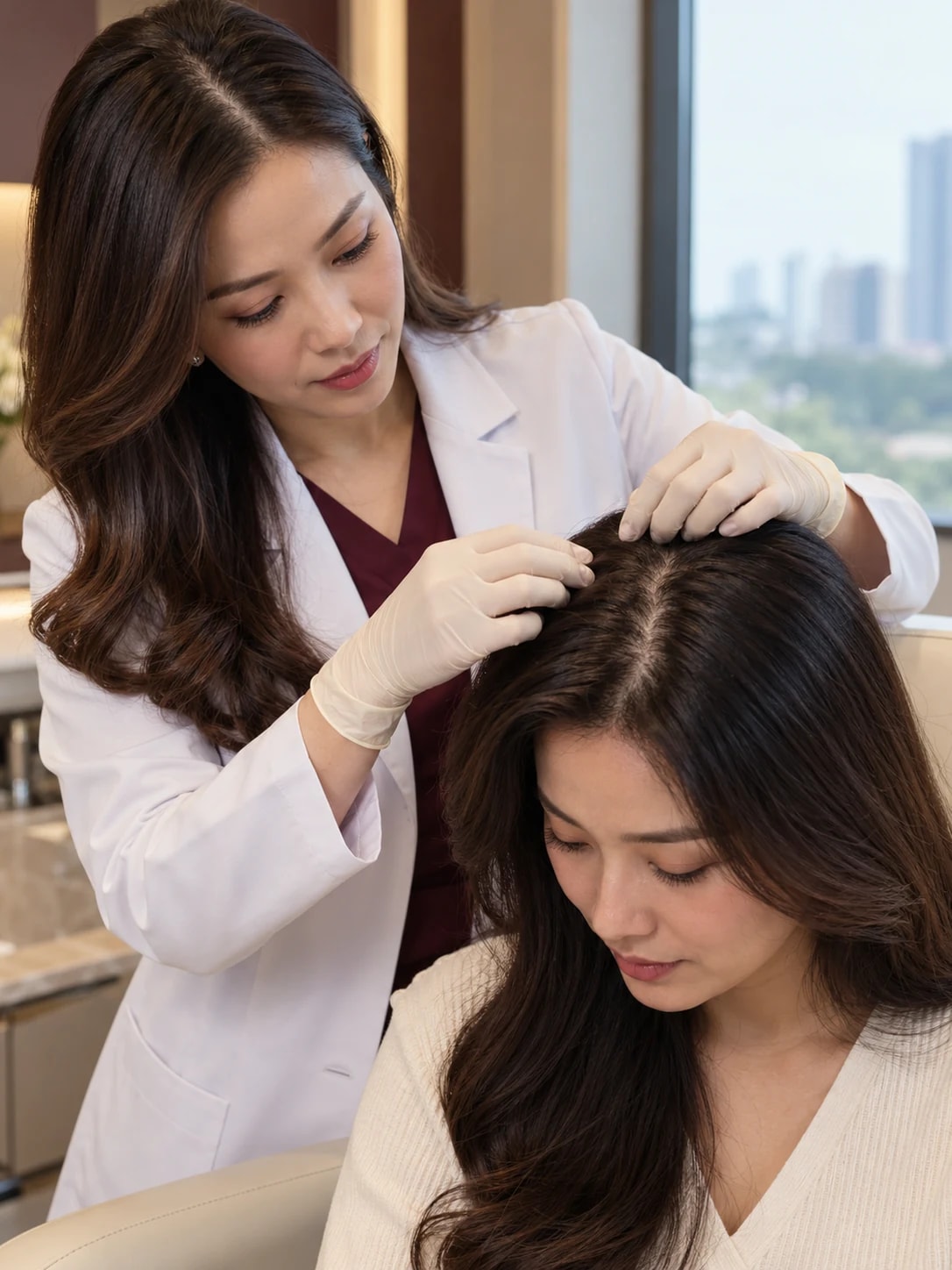
Ludwig staged
Hormone-aware planning
PRP hair treatment works by extracting a patient's platelet and growth factor-rich proteins from their own blood and placing them on the scalp, stimulating the follicles which have begun to miniaturize. The reason female pattern hair loss can be more complex than it is in men is because of the different hormonal and post-partum factors which may coincide with genetics.
Clinical Note
Female pattern hair loss typically presents as diffuse thinning on the crown and widening of the centre part, with the frontal hairline generally intact. This is different to male pattern baldness which is why a PRP injection focus differs between genders.
Unlike in men, whose hair loss is often more easily visible as a receding hairline and bald spot, women often present a less obvious pattern that can be difficult to diagnosis until it has already progressed significantly.
Doctors classify female pattern baldness on the Ludwig scale, ranging from Grade I to III, where Grade I sees some thinning on the part line and Grade III sees large areas of visible scalp on the crown. In a clinical setting, patients in the early stages (I and II) have shown marked improvement with the application of PRP treatments, which is why early intervention is typically the most successful.
While female pattern hair loss is officially called female androgenetic alopecia, it's rarely the sole reason behind thinning and proper consultation will seek to establish what combination of causes, if any, are affecting a patient.
| Cause | How It Affects the Scalp |
|---|---|
| Genetic androgenetic alopecia | Gradual follicle miniaturisation often across the crown |
| Post-partum hair loss | Temporary shedding 2 to 4 months after childbirth |
| Perimenopause and menopause | A decrease in oestrogen contributing to thinning and shorter growth phases |
| Thyroid imbalance | Both hypo and hyperthyroidism can cause diffuse shedding |
| PCOS | Hormonal imbalance can contribute to androgen-related thinning |
| Chronic stress or illness | Put follicles in telogen (resting) phase, known as telogen effluvium |
Cause
Genetic androgenetic alopecia
How It Affects the Scalp
Gradual follicle miniaturisation often across the crown
Cause
Post-partum hair loss
Cause
Perimenopause and menopause
Cause
Thyroid imbalance
Cause
PCOS
Cause
Chronic stress or illness
It's important to differentiate these conditions from each other clinically, since PRP treatment is far more effective on androgenetic alopecia than it is on a telogen effluvium brought on by an illness. If a woman presents to a consultation without knowing the root cause of her thinning, then a blood test and hormonal assessment is often necessary to confirm a diagnosis before commencing treatment.
PRP for female pattern hair loss is not a lesser version of the men's treatment, it has its own separate body of clinical research. A randomised, placebo-controlled trial from Cairo University, for example, treated women's scalps with PRP on one area and saline solution (placebo) on another, recording improvement after six months. The area which had received PRP injections saw an average increase in hair density of over 77 hairs per square centimetre compared to approximately 18 in the placebo area, as well as an increase in thickness of over three times greater than the untreated region.
Other double-blind studies published in the Journal of Dermatological Science and Dermatologic Surgery have also seen significant improvements in hair density and count when measuring at the three- and six-month points after a complete course of treatment. This is part of the reason why PRP has become the standard non-surgical option for women with early to moderate thinning, alongside prescription medications like minoxidil which work on a slightly different mechanism.
The patient profile for a woman seeking PRP tends to be somewhat specific, and being upfront about this at a consultation prevents false assumptions about what a PRP course can deliver.
Those who have entirely bald areas of scalp or have a long-standing bald spot generally will not benefit from PRP, since there are no follicles remaining to be stimulated and an FUE hair transplant is a more suitable option. It's far less common for women than men to present with entirely bald areas, due to the nature of female pattern baldness.
Combination treatments tend to be far more effective than PRP alone, and particularly once the cause of thinning has been identified and addressed.
| Combination | Why It's Beneficial |
|---|---|
| PRP + Minoxidil | Minoxidil lengthens the growth phase while PRP delivers growth factor |
| PRP + Mesotherapy | Provides additional vitamins and nutrients alongside the scalp rejuvenation |
| PRP + Thyroid / PCOS treatment | Addresses the underlying hormonal cause, improving PRP effectiveness |
| PRP + Exosome Therapy | Adds additional cellular messages for a more intense protocol |
Combination
PRP + Minoxidil
Why It's Beneficial
Minoxidil lengthens the growth phase while PRP delivers growth factor
Combination
PRP + Mesotherapy
Combination
PRP + Thyroid / PCOS treatment
Combination
PRP + Exosome Therapy
The protocol for these combinations generally follows the same pattern as discussed in the clinical note at the top of this page, with 4 to 6 sessions spaced roughly 4 to 6 weeks apart, before maintenance sessions every few months once the hair density has improved. Many women opt for mesotherapy combination treatments because it goes beyond the follicular rejuvenation of PRP alone and addresses the nutrition of the scalp.
Many women tend to discover PRP through other treatments, as the benefits of PRP therapy across both skin and hair cross over. The same concentrated platelet solution which stimulates follicles is used in treatments like RF microneedling combined with PRP for skin rejuvenation, and it's not uncommon for Malaysian women to explore both treatments following the same procedure.
Consultations for women begin with determining what is actually affecting the patient, rather than making assumptions.
There is clinical evidence that shows significant hair growth improvement in women, particularly in early stages of thinning.
Post-partum hair loss tends to resolve itself within a number of months, but is generally suitable for PRP treatment once it has stabilised.
Yes, once the underlying PCOS or thyroid imbalance is medically managed.
Most women require 4 to 6 initial sessions, in line with the clinical research cited above.
No, as bald patches indicate the follicles have been permanently lost. PRP can only work on follicles which are present and active.
Female pattern hair loss requires the same level of clinical attention as any other medical issue. A proper Ludwig staging and discussion of hormonal history will determine whether a PRP consultation is appropriate. Book a free consultation at Nexus Clinic KL to get an idea of what is causing your thinning, or message us on WhatsApp with any questions before booking.
✓ Reviewed by Dr. Ashvinia Bala, Aesthetic Medical Doctor at Nexus Clinic KL.
Real Google reviews from our patients, including those treated for PRP hair treatment.
Guides and answers from our doctors on this treatment.