 Hair Treatment
How to Choose the Right Hair Transplant Clinic in KL Without Regretting It Later
9 min read


Medically reviewed by Dr. Ashvinia Bala, MBBS (AIMST University), MMC Registration No. 82489 | Last reviewed:
While surgeons who are adept at hairline work are not necessarily adept at crown work, this can be an important consideration when vertex thinning is specifically an issue.
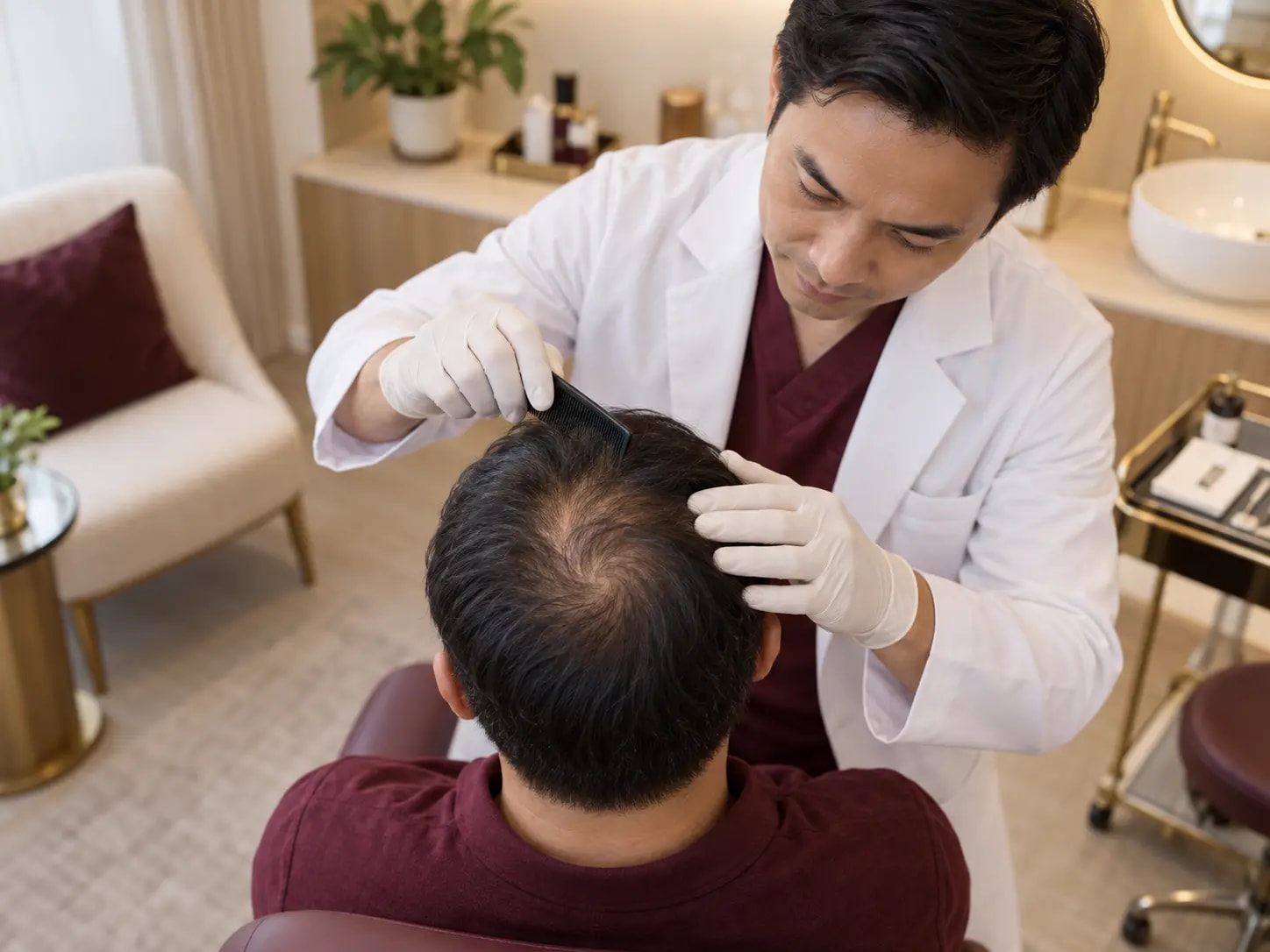
Whorl Mapping
Vertex restoration
The crown is the circular area at the top-back of the scalp on which hair radiates outwards in a spiral away from a central parietal whorl, and recreating this spiral growth pattern with transplanted grafts requires a fundamentally different skill set to designing a straight, forward-facing hairline.
Important Clinical Note
Crown procedures at Nexus Clinic KL involve initial mapping of your individual whorl direction and donor supply before any graft plan is proposed, as these factors determine whether surgery is currently advisable.
Hair across most of the scalp points in a broadly consistent direction, which naturally hides minor flaws with layering and overlapping.
At the crown, hair rotates a full 360 degrees around a central point, which means even minor inconsistencies in graft angle create a visibly patchy appearance.
A few structural factors contribute to the difficulty:
Timing is genuinely more important for crown cases than virtually any other area of hair transplant surgery.
Patients with a defined, stable pattern (generally Norwood stage 3 vertex through 5) tend to make the strongest candidates, as there is a clear boundary to design a graft plan on.
Younger patients whose crown thinning is still actively spreading are often better served by delaying surgery, as surrounding hair loss can continue to progress around an earlier transplant and leave an isolated patch of transplanted hair.
Sufficient donor supply is essential, as the crown disproportionately uses a large share of available grafts for its size.
More advanced Norwood 6 or 7 cases may need to prioritise other areas as a result, due to the limited donor hair remaining once multiple zones are fighting for it.
| Extent of Crown Thinning | Typical Graft Range |
|---|---|
| Small, early vertex thinning | 800 to 1,500 grafts |
| Moderate, well-defined bald patch | 1,500 to 2,500 grafts |
| Larger area extending towards the mid-scalp | 2,500 to 4,000+ grafts |
Extent of Crown Thinning
Small, early vertex thinning
Typical Graft Range
800 to 1,500 grafts
Extent of Crown Thinning
Moderate, well-defined bald patch
Extent of Crown Thinning
Larger area extending towards the mid-scalp
Complete density restoration is rarely realistic here, and should not generally be the goal. A well-executed crown transplant creates balanced, natural-looking coverage rather than an exact recreation of your original density, which is simply not achievable due to donor limitations.
This is the actual technical core of the crown surgery. Instead of placing grafts on one consistent angle, the surgeon has to follow the spiral direction of your natural growth pattern and continuously adjust graft angles as placement progresses around the central point. Executed well, this recreates the sense of hair flowing outwards as it always did. Executed poorly, it results in a flat, obviously artificial patch (even with a respectable graft count).
Healing follows the same FUE pattern seen elsewhere on the scalp generally, although full maturation of the grafts at the crown tends to take longer than hairline procedures (12 to 18 months versus 9 to 12 months on average). Mild redness and the usual shedding phase occurs in the early weeks, with gradual new growth forming over the following months.
Not every patient with crown thinning is ready, or a candidate, for surgery right away. Our piece on what PRP therapy is and how it helps with hair and skin walks through how PRP works to support existing follicles, which can be a valuable option for patients who have early stage crown thinning who are not currently candidates for surgery, or wish to strengthen surrounding hair around a future transplant. PRP hair treatment itself is something we also offer directly, as part of an ongoing minoxidil or finasteride regimen to help slow further thinning around the treated area.
For patients whose crown thinning is quite progressed that donor supply genuinely does restrict surgical options, or who wish to have a solution without surgery at all, it might be worth reading our article on scalp micropigmentation in KL as a permanent solution for hair loss, which walks through how this technique can create the visual appearance of density using pigment rather than transplanted follicles, sometimes used on its own and sometimes to camouflage areas surgery can't fully cover.
If your thinning extends beyond just the crown, our broader hair loss treatment page talks through how doctors weight surgical and non-surgical options depending on your pattern.
At Nexus Clinic's hair treatments hub, crown cases are assessed for pattern stability before any graft plan is finalised, as treating a still-progressing pattern carries genuine long-term risk that can easily be overlooked in a rushed consultation. Whorl direction is individually mapped, and donor supply is planned with conservatism in mind to protect your future options. Younger patients with early crown thinning are often steered towards medical management or PRP, and those who have a stable, well-defined pattern receive a graft plan designed for long-term natural coverage.
The crown's spiral whorl pattern requires continuously shifting graft angles, unlike the hairline's more uniform direction.
Most cases need between 800 and 4,000 grafts depending on the extent of thinning, generally more than a comparable hairline correction due to the surface area being covered.
Often not immediately. Younger patients with early, still spreading crown thinning are often advised to try medical treatment or PRP first, as the pattern tends to progress with age.
It is a technique that uses pigment to create the visual appearance of density on the scalp. It can be used alone for patients not ready for surgery, or alongside a transplant to camouflage areas surgery can't fully cover.
Crown results typically take slightly longer than hairline work, and reach their final appearance between 12 and 18 months after surgery.
The transplanted hair is permanent, but surrounding native hair can continue to thin over time, which is why many patients combine surgery with ongoing medical treatment.
Crown surgery relies on your individual whorl pattern, donor supply and the stability of your thinning, each of which requires a proper in-person assessment. Book a free consultation with Nexus Clinic KL, or message us on WhatsApp if you have questions before booking.
✓ Reviewed by Dr. Ashvinia Bala at Nexus Clinic KL
Real Google reviews from patients who came to Nexus Clinic for FUE hair transplants.
Guides and answers from our doctors on this treatment.
Hair Treatment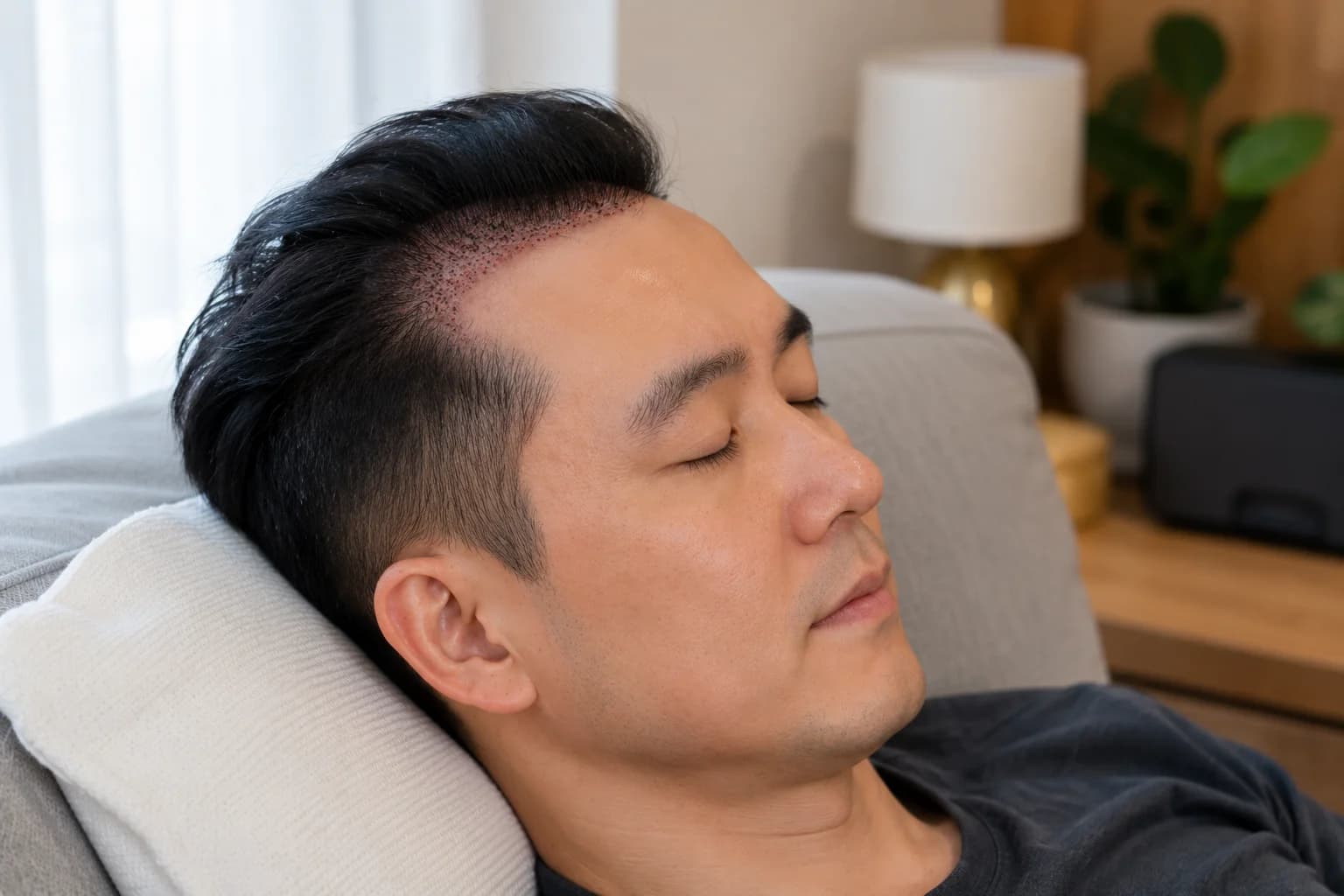 Hair Treatment
 Hair Treatment