 Hair Treatment
How to Choose the Right Hair Transplant Clinic in KL Without Regretting It Later
9 min read


Medically reviewed by Dr. Ashvinia Bala, MBBS (AIMST University), MMC Registration No. 82489 | Last reviewed:
Not all men who are losing their hair require the same treatment, and not all men who are losing their hair need FUE at all. The Norwood scale, the established method for classifying male pattern baldness from stage 1 to 7, not only informs on how much hair has been lost, but also influences what FUE approach is appropriate, how many grafts are required and occasionally whether hair loss treatment should begin with an alternative to surgery.

Tailored by Norwood Stage
Donor supply first
Important Clinical Note
At Nexus Clinic KL, male FUE candidates are assessed against their Norwood stage and donor supply together due to the fact the same graft count can yield greatly different results based on how far advanced the pattern of loss is.
Testosterone by-product DHT causes follicles to weaken and shed in a fairly predictable sequence across most men, which is why the Norwood scale serves as a planning tool, as well as a diagnostic tool.
Men at Norwood 2 or 3 are typically advised that they could realistically bring their hairline back towards that earlier position; men at 4a and beyond require a different discussion, focused on how to get the most out of the donor hair available to strategically restore a full head of hair.
This is a point that can trip up many men initially, as the default request is for the hairline they had at twenty, but surgeons tend to focus on restoring it to a mature Norwood 2 or 3 position, slightly higher and further back than a teenage hairline would be. It photographs and ages better over the decades, while it also leaves more donor hair available if a second procedure is ever needed in the future. A low, aggressive hairline can look great on day one, but increasingly out of place as the rest of their natural hair pattern evolves with age.
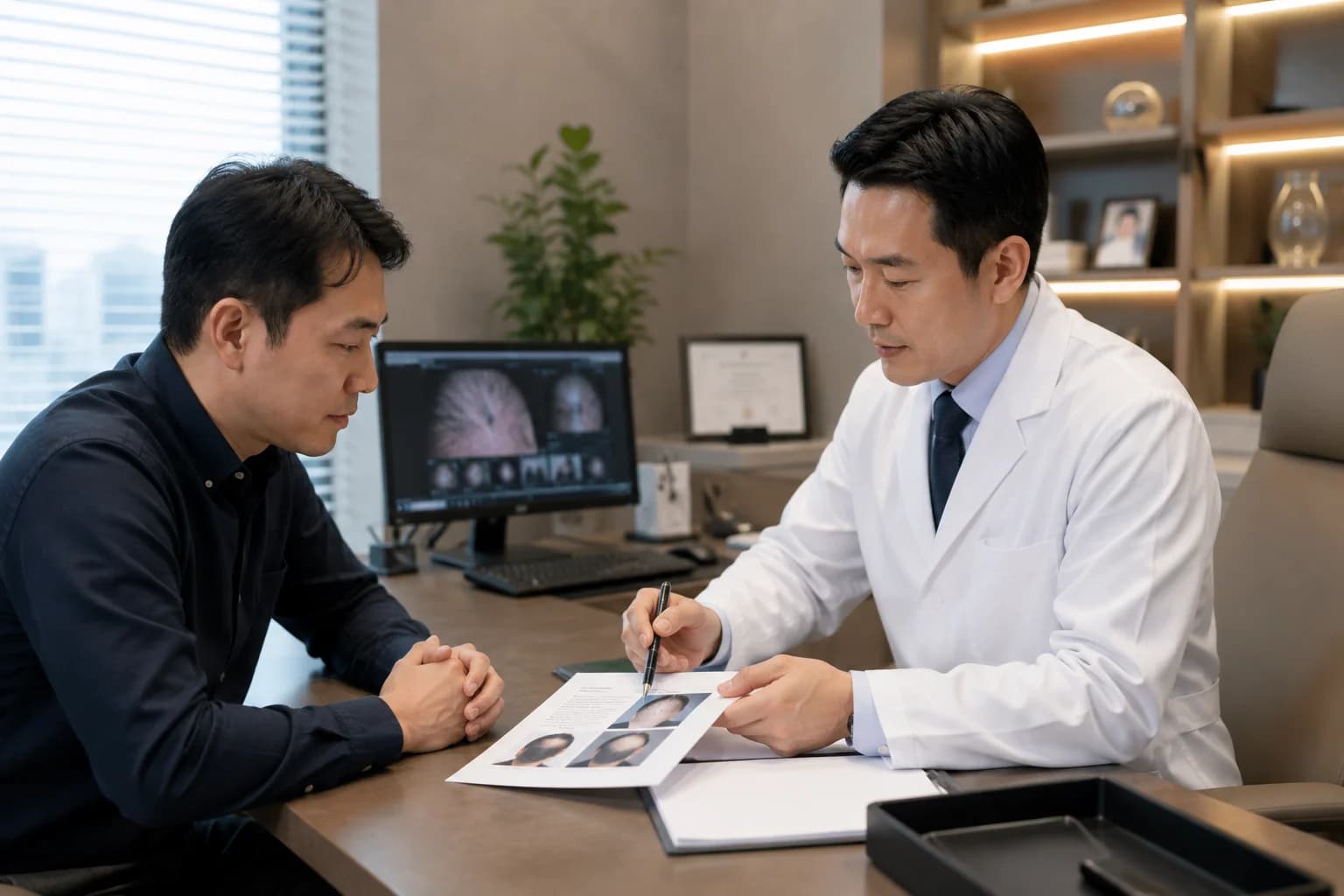
A proper first consultation extends well beyond simply looking at your scalp. Expect your surgeon to classify your Norwood stage, assess the donor density at the back and sides of your head, inquire about family history given the genetic nature of male pattern baldness and discuss how your hair loss has progressed over recent years as oppose to simply noting where it is currently. This background genuinely influences the recommendation. Two men presenting with identical current hairlines could receive very different advice due to the fact one has a family history of aggressive, early progression while the other does not. A consultation without these questions and a move straight to a graft count and price misses out on what determines whether surgery can be appropriate now.
Graft availability is not unlimited, and this tends to be especially important for men further along the Norwood scale.
| Norwood Stage | Typical Graft Range | Planning Priority |
|---|---|---|
| 2 to 3 | 1,200 to 2,000 grafts | Restore hairline to a mature position |
| 4 to 5 | 2,000 to 3,500 grafts | Balance hairline and mid-scalp coverage |
| 6 to 7 | 3,500 to 5,000+ grafts, sometimes staged | Strategic coverage, donor conservation critical |
Norwood Stage
2 to 3
Typical Graft Range
1,200 to 2,000 grafts
Planning Priority
Restore hairline to a mature position
Norwood Stage
4 to 5
Norwood Stage
6 to 7
At the high end, the discussion you have with your surgeon is less about achieving full density and more on where limited grafts will make the most of the visual impact, usually the hairline and frontal third, as oppose to spreading thin across the entire scalp.
A 24 year old at Norwood 3 and a 45 year old at Norwood 3 are not the same case, despite sharing a classification. Younger men whose hair loss is still actively progressing are frequently advised to slow things down with either minoxidil or finasteride prior to committing to surgery, as operating over a pattern that will continue to expand can see transplanted hair surrounded by new areas of loss. Men whose pattern has genuinely stabilised, often in their late thirties or beyond, tend to make more predictable surgical candidates.
FUE rarely presents as the sole intervention in a man's treatment. PRP hair treatment is frequently utilised to support graft survival and strengthen surrounding native hair in the healing, while men dealing with facial hair concerns in tandem with scalp thinning often ask about beard transplant procedures during the same consultation, as the extraction principle is directly applicable.
The most common cause of disappointment in male FUE patients is not poor surgery, but mismatched expectations prior to surgery. A Norwood 6 patient hoping for the density of someone who began at Norwood 3 is chasing a result their donor supply will not physically be able to allow. A good consultation addresses this honestly rather than after you've committed financially.
At Nexus Clinic's hair treatments hub, every male patient is classified by Norwood stage and assessed for progression stability before a graft plan is proposed. Younger men with actively progressing loss are often steered towards medical management first, while men with a stable, well-defined pattern will receive a graft plan focused on realistic long-term coverage rather than an unrealistic ideal. Where donor supply is limited, priority areas are discussed openly so you know what your grafts will and won't be able to accomplish.
Norwood 2 to 5 tend to be the most straightforward candidates due to a well-defined pattern and sufficient donor supply, while Norwood 6 and 7 require more strategic planning.
It is often more appropriate to stabilise the pattern first, as operating around the ongoing hair loss will leave transplanted hair surrounded by new areas of loss later.
A mature, slightly higher hairline tends to age better and preserve more donor hair, while a very low hairline can become increasingly out of place over the years.
It depends on the Norwood stage, ranging from roughly 1,200 grafts for early hairline work to 5,000 or more for advanced, staged cases.
Rarely to original density. At advanced stages, the focus moves to strategic coverage of priority areas rather than complete restoration due to limited donor supply.
Yes. Younger men with still progressing loss are often advised to wait or utilise medical treatment, while men with a stabilised pattern tend to be more appropriate candidates.
A proper assessment informs you more than any online scale comparison ever could. Book a free consultation with Nexus Clinic KL or message us on WhatsApp if you have questions ahead of booking.
✓ Reviewed by Dr. Ashvinia Bala at Nexus Clinic KL
Real Google reviews from patients who came to Nexus Clinic for FUE hair transplants.
Guides and answers from our doctors on this treatment.
Hair Treatment Hair Treatment
 Hair Treatment