 Hair Treatment
How to Choose the Right Hair Transplant Clinic in KL Without Regretting It Later
9 min read


Medically reviewed by Dr. Ashvinia Bala, MBBS (AIMST University), MMC Registration No. 82489 | Last reviewed:
A hairline transplant is measured by one, simple criteria: does it look natural. Unlike density restoration in the middle of the scalp, which has room for imperfection, the hairline is the most prominent feature of your face, lit for inspection from every angle people pass you by.
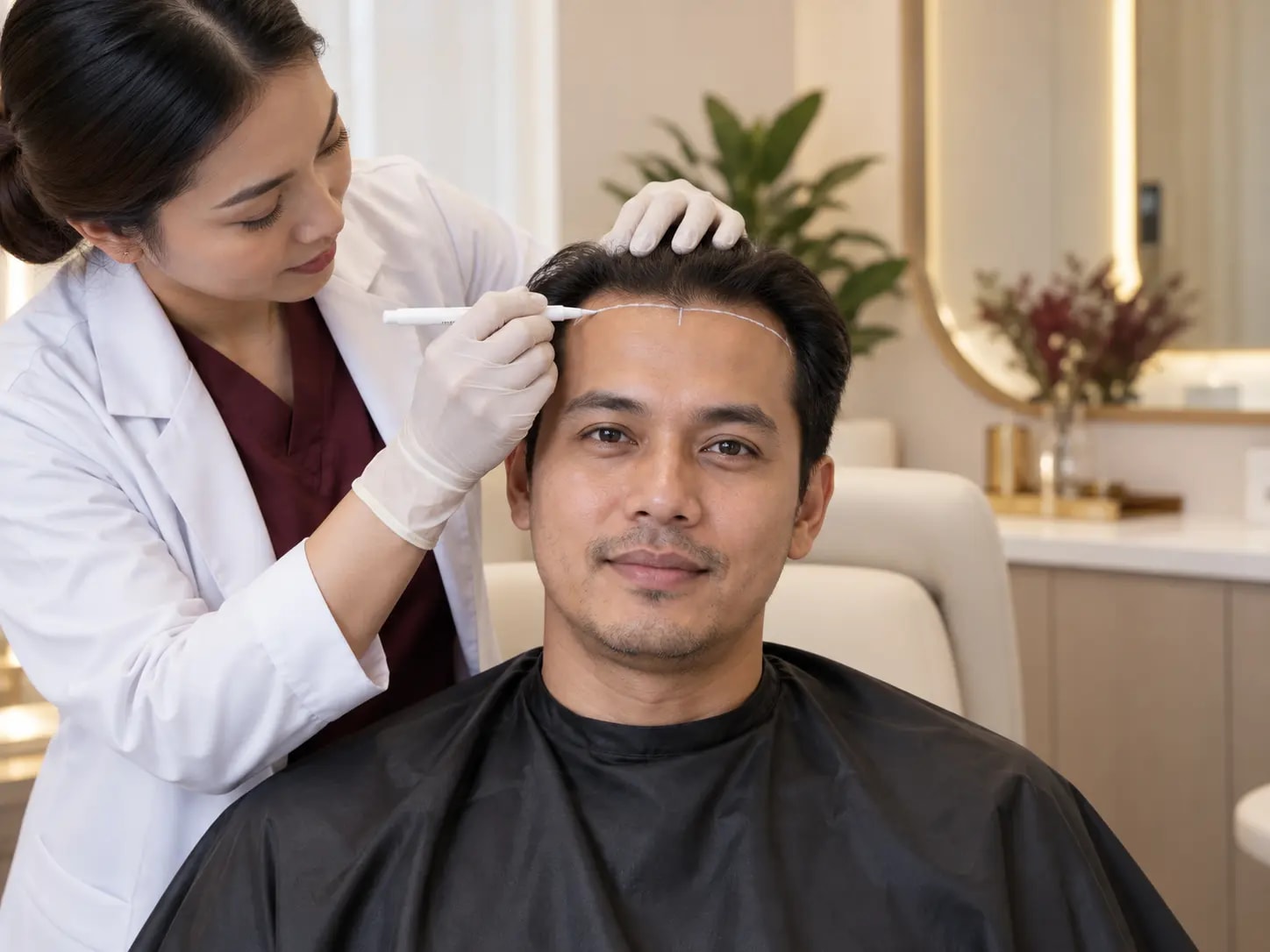
Natural Hairline Design
Age-appropriate placement
Surgeons will describe hairline design as both a science and an artform, and not without reason. It requires an understanding of aesthetics in facial proportion and age, and the way hair is angled and layered to avoid the 'painted on' look which immediately gives away a bad transplant.
Important clinical note
Hairline design at Nexus Clinic KL is based on individual patient assessment against facial proportion and age-appropriate placement, using single-hair grafts on the front edge to create a transition zone rather than a dense edge.
A natural hairline is not a straight line. It consists of several 'zones' which need to be present for a hairline to appear natural, and the failure to include any one of these contributes significantly to the tell-tale 'obviously transplanted' look.
| Zone | Purpose |
|---|---|
| Transition zone | Single-hair grafts create a soft, irregular front edge |
| Frontal tuft | Slightly denser area just behind the transition zone |
| Temporal points | The angled corners on either side of the face |
| Lateral humps | Smooth the front hairline into the temple and side hair |
Zone
Transition zone
Purpose
Single-hair grafts create a soft, irregular front edge
Zone
Frontal tuft
Zone
Temporal points
Zone
Lateral humps
Skipping the temporal points is a common error when rushing a procedure, as it can appear natural in the twenties but suspicious as an adult when the natural recession of the hairline has taken place.
One of the most counter-intuitive aspects of hairline design is that recreating a teenage hairline is often the wrong choice, despite being the most common request.
This is partly why an experienced surgeon may push back against a request for a very low, dense hairline, not because they are being unreasonable but because it ages poorly and can restrict options if further hair loss progresses.
No two hairline plans look the same, because no two faces or heads of hair are the same. A proper design requires several considerations before any grafts are placed.
A well-documented design can be undone in a single step if the execution does not match it. To achieve a natural hairline generally requires the consistent use of certain techniques along the front edge.
This is why extraction technique is so important, as any good hairline design must rely on this foundation. Our FUE hair transplant page details how individual grafts are extracted and placed using these techniques.
A hairline transplant rarely works in isolation from the rest of one's hair restoration plan. Many patients opt to pair it with ongoing treatment to protect the hair surrounding the new hairline, since a beautifully designed hairline which is then surrounded by thinning eventually begins to look disconnected from the rest of the scalp.
Medical treatments such as minoxidil or finasteride are commonly used alongside a hairline procedure to slow further recession in the surrounding area, while options such as PRP hair treatment or exosome hair treatment are sometimes used to support graft health and density during recovery. If your hair loss includes diffuse thinning across your scalp rather than being isolated to the hairline, our broader hair loss treatment page outlines how surgeons weigh surgical and non-surgical options against your loss pattern.
We are also currently working on dedicated pages covering hairline transplant pricing, before and after timelines specific to hairline design work, and recovery timelines for this specific area, which will be linked from this page once available.
At the Nexus Clinic hair treatments hub, every hairline procedure begins with a facial assessment rather than a graft count. Age, facial proportion, hair caliber and future hair loss projection are all taken into account to produce a design which will still look appropriate in twenty years' time, not just the months following surgery.
A juvenile hairline sits low and can look increasingly artificial as you age, since natural hairlines continue to recede slightly through adulthood. Surgeons generally recommend a slightly higher, age-appropriate placement instead.
A straight, dense front edge without natural irregularity, and closed temporal points which do not occur naturally in most hairlines.
It is possible in some cases, but far more limited than raising one, since bringing a hairline up again can leave visible scarring. Surgeons generally prefer to plan conservatively from the start.
No. Male hairlines typically include defined temporal points, while female hairlines are usually designed rounder, lower, and more symmetrical across the front.
Single-hair grafts create a soft, natural transition zone. Placing thicker two or three hair grafts on the very front edge creates an unnaturally dense line which looks obviously artificial.
Yes. Hair texture and typical growth patterns vary across ethnic backgrounds, and a well-planned design takes this into account rather than applying one template to every patient.
A natural hairline depends entirely on individual facial assessment, not a template applied to everyone. Book a free consultation with Nexus Clinic KL, or message us on WhatsApp if you have questions before deciding.
✓ Reviewed by Dr. Ashvinia Bala at Nexus Clinic KL
Real Google reviews from patients who came to Nexus Clinic for hair transplants.
Guides and answers from our doctors on this treatment.
Hair Treatment Hair Treatment
 Hair Treatment