 Hair Treatment
How to Choose the Right Hair Transplant Clinic in KL Without Regretting It Later
9 min read


Medically reviewed by Dr. Ashvinia Bala, MBBS (AIMST University), MMC Registration No. 82489 | Last reviewed:
FUE and FUT both essentially perform the same function, transferring healthy hair follicles from a donor area to a thinning or balding region. The fundamental difference appears to be in the method of extraction, from which everything else, from scarring to session size and patient suitability flows. Knowing what that trade-off means in the bigger picture is probably more enlightening than picking one FUE hair transplant technique simply on the name.
FUE or FUT?
Scarring • Recovery • Yield
Important Clinical Note
At Nexus Clinic KL, FUE is the technique adopted in the vast majority of cases, with FUT retained only in specific situations such as a previously scarred donor area or very large graft requirements.
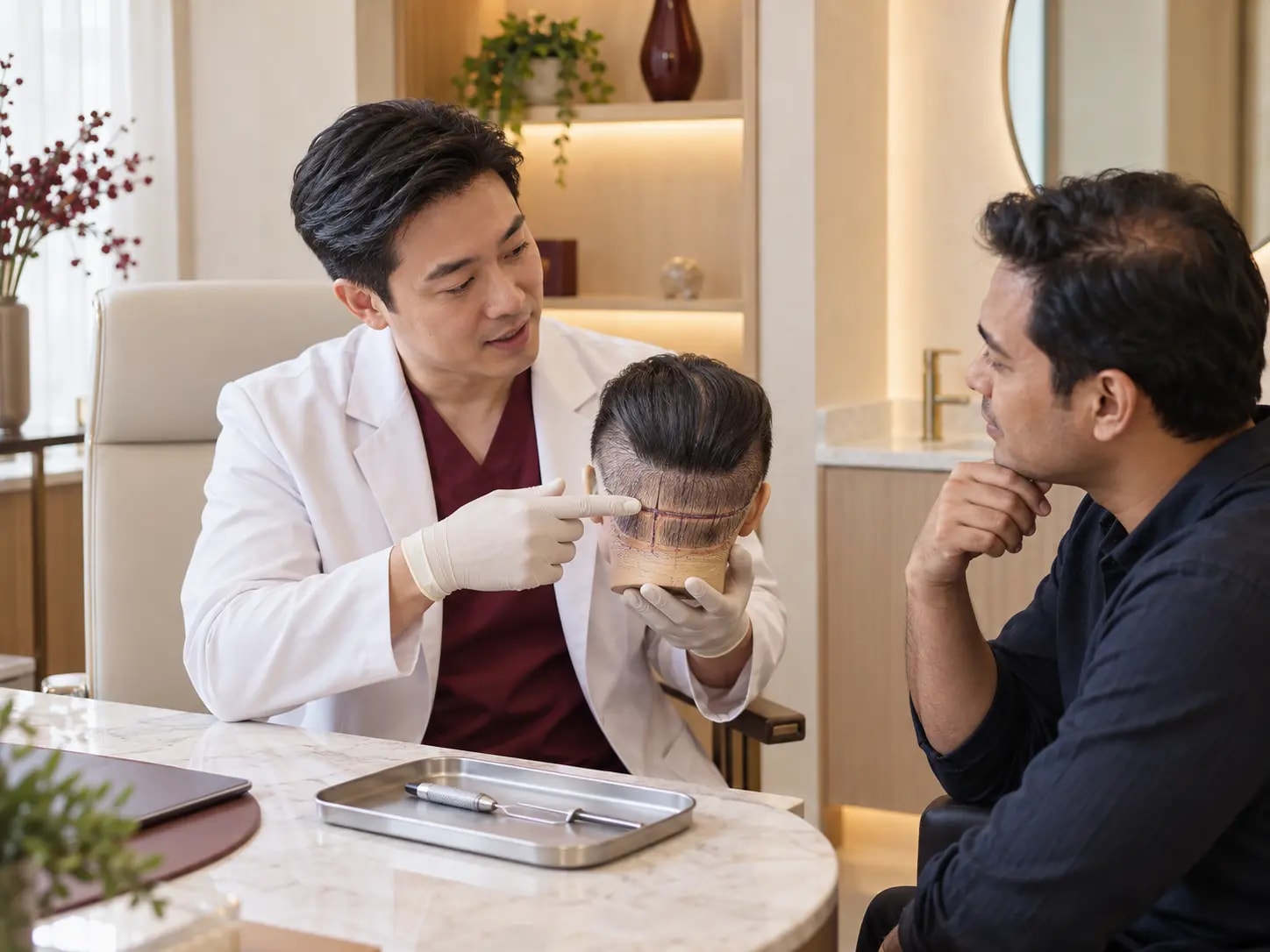
FUT, or strip harvesting, removes a strip of scalp from the donor area which is then sutured up and dissected under a microscope by a technician team into grafts. FUE, by contrast, removes each follicular unit one at a time from the scalp and is devoid of any strip removal and suture required.
This one difference explains the rest.
FUT leaves behind a single linear scar across the back of the head which, although usually thin, can widen in some people and be visible with very short hairstyles.
FUE leaves behind scattered dot scars across the donor area, usually far less noticeable than the FUT scar but can still be visible under short hair if the procedure is poorly executed or overharvested.
The FUT scar is hidden typically by keeping the donor hair at least half an inch in length.
With FUE, much shorter styles are possible, sometimes down to a grade 1 or 2 buzz, without the presence of the scar.
If the ability to hide scarring under a short or shaved hairstyle is important to you, this is probably the reason you're reading this. If you're looking at the options of surgery versus non-surgery entirely, our previous piece on what PRP therapy is and how it helps with hair and skin is worth your time reading, to understand why a PRP treatment would be completely devoid of any scarring question.
FUE generally has a gentler recovery as there is no strip removal and suture to contend with. Soreness in the donor area is generally milder and lasts for a shorter time in FUE than in FUT which may have to contend with tightness and stitch care for a period of one to two weeks. Both techniques also share a broadly similar overall recovery timeline for the recipient area, as this aspect of the procedure, the implant of grafts in the thinning zone, is essentially identical between the techniques. If you're looking for the whole week by week picture of what recovery entails, regardless of the technique you've chosen, our page on hair transplant recovery goes into that in more detail.
This is a part that FUE advocates can often downplay. FUT can typically yield a higher number of grafts in a single session as removing a strip of hair captures a large volume of the donor's hair at once in an efficient way. Sessions of FUE, especially extremely large ones, take a considerably longer amount of time and can approach 6 to 9 hours in the chair, compared to around 4 to 8 hours for a comparable FUT session.
Some published figures put average FUT graft yield at around 90 to 95%, compared to around 75 to 90% for FUE, as FUT grafts have slightly more surrounding tissue that is retained during dissection and are more gentle to deal with, whereas FUE grafts can be more fragile in certain stages of the session, especially with longer sessions where technician fatigue can be a factor.
| Factor | FUE | FUT |
|---|---|---|
| Scarring | Tiny dot scars | Single linear scar |
| Best for hairstyle | Short or shaved styles | Medium to long hair covering the scar |
| Typical graft yield per session | Slightly lower on average | Often higher, more efficient for large sessions |
| Recovery comfort | Generally milder, no sutures | Some tightness, stitch care for 1 to 2 weeks |
| Repeat procedures | Can become more difficult with repeated donor scarring | Can often be followed later by FUE if needed |
| Cost per graft | Typically slightly higher | Often marginally lower |
Factor
Scarring
FUE
Tiny dot scars
FUT
Single linear scar
Factor
Best for hairstyle
Factor
Typical graft yield per session
Factor
Recovery comfort
Factor
Repeat procedures
Factor
Cost per graft
FUT is not obsolete, despite the dominance of FUE in most modern clinics. It genuinely suits certain cases:
For the vast majority of patients, especially those wanting styling flexibility or shorter hairstyles, FUE remains the commonly recommended route, part of the reason it has become the default technique in most clinics, including our own. Our comparison piece on PRP hair vs hair transplant treatment in Malaysia is also worth reading if you're still deciding between surgery in general and a non-surgical route, regardless of which surgical technique you'd be considering in the end.
Pricing between FUE and FUT is generally similar in the big picture, though FUE tends to run marginally higher per graft as FUT's dissection work tends to be more efficient as a dedicated technician team works on an already-removed strip. If pricing considerations matter to your decision, it's worth discussing both options directly at a consultation rather than comparing generic online figures, as your donor supply and graft count needs will determine the real number in either case.
Regardless of the technique you choose, many patients opt for ongoing minoxidil to protect their native hair. PRP hair treatment is commonly used separately for helping graft survival during healing, and some patients take finasteride longer term as part of their maintenance.
Neither FUE nor FUT is the right answer if surgery itself is not yet the appropriate stage of treatment for you. Our broader hair loss treatment page walks through how doctors weigh surgical against non-surgical options depending on your pattern of loss, and our piece on stem cell and PRP therapy leading hair restoration in 2026 covers some of the regenerative approaches increasingly looked at alongside or instead of either surgical technique.
At Nexus Clinic's hair treatments hub, FUE is recommended for the overwhelming majority of patients, given its advantage in scarring and styling, but FUT is genuinely available and discussed honestly for cases where it offers a real clinical advantage, such as a previously scarred donor area or exceptionally large graft requirements. The decision is made based on your specific scalp and goals, not a default answer applied to everyone.
Not categorically. FUE tends to shine in scarring and recovering comfort, while FUT can offer higher graft yield per session, so the better one depends on your specific case and priorities.
FUE in general, as its scattered dot scars are far less noticeable than FUT's single linear scar, which is typically only hidden with longer hairstyles.
Often yes, FUE can follow an earlier FUT procedure, though the reverse is more limited as FUE scarring across the donor area can complicate a later strip harvest.
FUT grafts have more surrounding tissue that is retained during microscopic dissection, while FUE grafts are more exposed during extraction, which can slightly affect survival rates, particularly in longer sessions.
Often marginally, as FUT's dissection process tends to be more efficient per graft, though the actual difference depends heavily on your clinic and graft count.
FUE, as it avoids the linear scar that FUT leaves, which is typically only hidden with longer hair covering the donor area.
The right choice between FUE and FUT depends on your donor area, graft needs and styling preferences, rather than a general ranking of one over the other. Book a free consultation with Nexus Clinic KL, or message us on WhatsApp if you want to talk through your options before making a decision.
✓ Reviewed by Dr. Ashvinia Bala at Nexus Clinic KL
Real Google reviews from patients who came to Nexus Clinic for FUE hair transplants.
Guides and answers from our doctors on this treatment.
Hair Treatment Hair Treatment
 Hair Treatment