 Hair Treatment
How to Choose the Right Hair Transplant Clinic in KL Without Regretting It Later
9 min read


Medically reviewed by Dr. Ashvinia Bala, MBBS (AIMST University), MMC Registration No. 82489 | Last reviewed:
FUE side effects share significant overlap with general hair transplant side effects, as both procedures share the act of relocating hair follicles and the healing of wounded scalp tissue. However, the technique of thousands of individual punches rather than a single strip incision means there are a few key differences worth understanding.
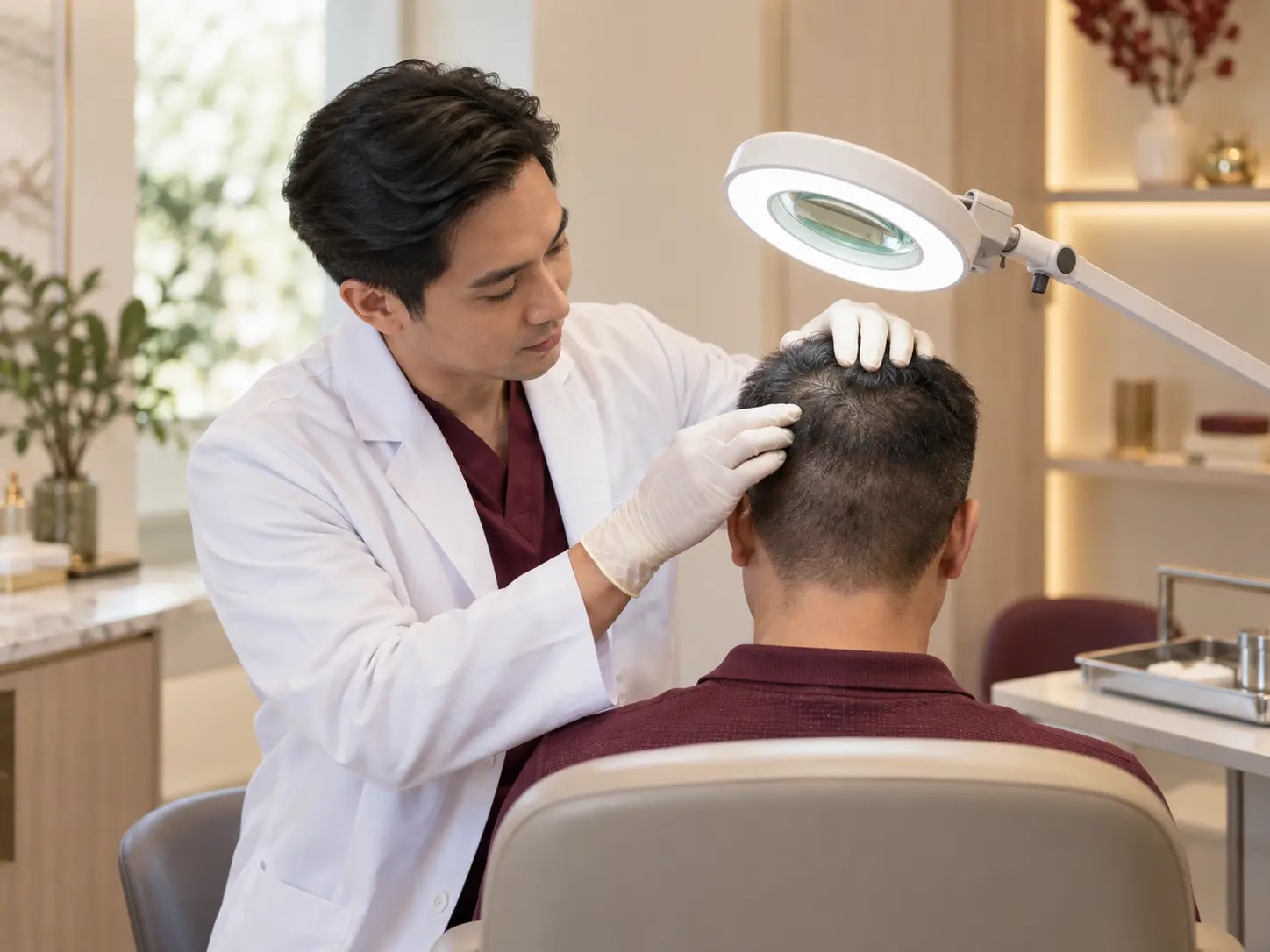
Safe Donor Zone
Doctor-led extraction
Important Clinical Note
FUE extraction performed within the safe donor area and using appropriate punches sizes at Nexus Clinic KL reduces the risk of overharvesting and visible donor thinning.
These show up in some form for almost all FUE patients and are simply the result of the scalp healing rather than something to be concerned about.
Itching in particular is worth mentioning here, as it often peaks as healing accelerates and thus has the potential to be at its worst just as improvement is beginning to be seen. Avoid scratching, as this is the only instinct one should try to resist due to posing a risk of dislodging grafts that have not yet properly anchored.
Small inflamed bumps around individual hair follicles, known as folliculitis, are fairly common in the aftermath of FUE specifically due to the fact that each punch site is technically its own wound that can become irritated as hair tries to push through. Some cases actually arise from actual bacterial infection but many are simply sterile inflammation without any infection present. Either way, it typically resolves within days or weeks and rarely requires a course of any treatment outside of a topical cream the clinic can prescribe.
Numbness or reduced sensation across the donor and recipient sites is reported by most FUE patients due to minor nerve disruption during extraction and graft placement, with most seeing sensation return within two to three months. Numbness beyond that is rare and worth flagging for your surgeon, but it is also rarely a sign of anything permanent.
This is genuinely the side effect that is most specific to FUE technique as a whole, so it's worth understanding it properly before considering a hair transplant vs PRP comparison, since the risk profile for this side effect is vastly different between the approaches. Due to grafts being extracted one at a time rather than as a single strip, an inexperienced or rushed surgeon can end up taking too many follicles from too concentrated an area, or outside what surgeons refer to as the safe donor zone, the region of hair that is genetically resistant to future thinning.
The consequences of overharvesting include:
This is one of the clearest reasons why surgeon experience matters more in FUE than the reputation for simplicity may suggest. A rushed high volume session with inexperience extraction technique is where most overharvesting cases originate.
FUE can occasionally trigger telogen effluvium, a temporary shedding of your existing native hair surrounding the treated area, separate from the expected shock loss of the transplanted grafts themselves. This can be genuinely unsettling to notice, as it looks like the procedure is making things worse rather than better, but it typically resolves within several months as the hair cycle stabilises.
These affect a minority of patients, generally under 1% by published figures, but it's worth knowing them in case they do occur.
Warning signs that warrant prompt attention rather than patience include worsening pain instead of gradual improvement, spreading warmth or redness, foul smelling discharge, or fever.
A few factors are consistently what distinguish patients with a smooth FUE recovery from those with avoidable complications, and many of them directly relate to the surgeon and clinic you choose rather than anything within your own control once surgery has begun.
Some patients reduce their overall risk profile by pairing surgery with regenerative support; an approach discussed in the article about stem cell and PRP therapy leading hair restoration in 2026, which covers how these newer treatments are commonly used alongside FUE to support healing and reduce shedding in the surrounding native hair.
If the FUE side effect list poses too many risks to your willingness to undergo treatment at the moment, PRP hair treatment or mesotherapy both carry a considerably lighter side effect profile since neither of these involve extraction or incision at all. These are not a direct substitute for a fully bald patch but for earlier stage thinning they are genuinely worth ruling out first. Ongoing use of minoxidil or finasteride alongside either surgical or non-surgical treatment can also help to protect existing hair regardless of your choice.
At the Nexus Clinic hair treatments hub, FUE extraction is planned with the safe donor zone mapped out before any grafts are taken which is the single biggest factor in avoiding overharvesting. Sterile technique and use of appropriately sized punch tools takes place, while patients are given clear aftercare guidance covering the specific healing pattern FUE produces rather than a generic hair transplant instruction sheet that does not account for the technique's specific extraction pattern.
No, generally not, as once the donor area has been overharvested, the resulting thinning is typically permanent.
Fairly common, affecting a meaningful portion of patients to some degree, though it is usually mild and resolves within one to two weeks with basic care.
Not necessarily more, but different ones. FUE avoids the linear scarring of FUT but carries its own specific risk of donor overharvesting.
Rarely; most patients regain full sensation within two to three months and permanent numbness is uncommon when proper extraction technique is used.
Occasionally, through temporary telogen effluvium affecting native hair near the treated area. This is usually temporary and resolves within several months.
Worsening pain, spreading redness or warmth, discharge or fever are signs to contact your clinic promptly rather than waiting to see on its own.
Understanding the FUE-specific risks is the best preparation for surgery, and a proper consultation is where these get real answers. Book a free consultation with Nexus Clinic KL, or message us on WhatsApp if you have specific concerns before booking.
✓ Reviewed by Dr. Ashvinia Bala at Nexus Clinic KL
Real Google reviews from patients who came to Nexus Clinic for FUE hair transplants.
Guides and answers from our doctors on this treatment.
Hair Treatment Hair Treatment
 Hair Treatment